Outbound Sequence Personalization Variables That Move Reply Rates
Signal-based triggers and buyer-role tailoring separate top campaigns from the rest of the field.
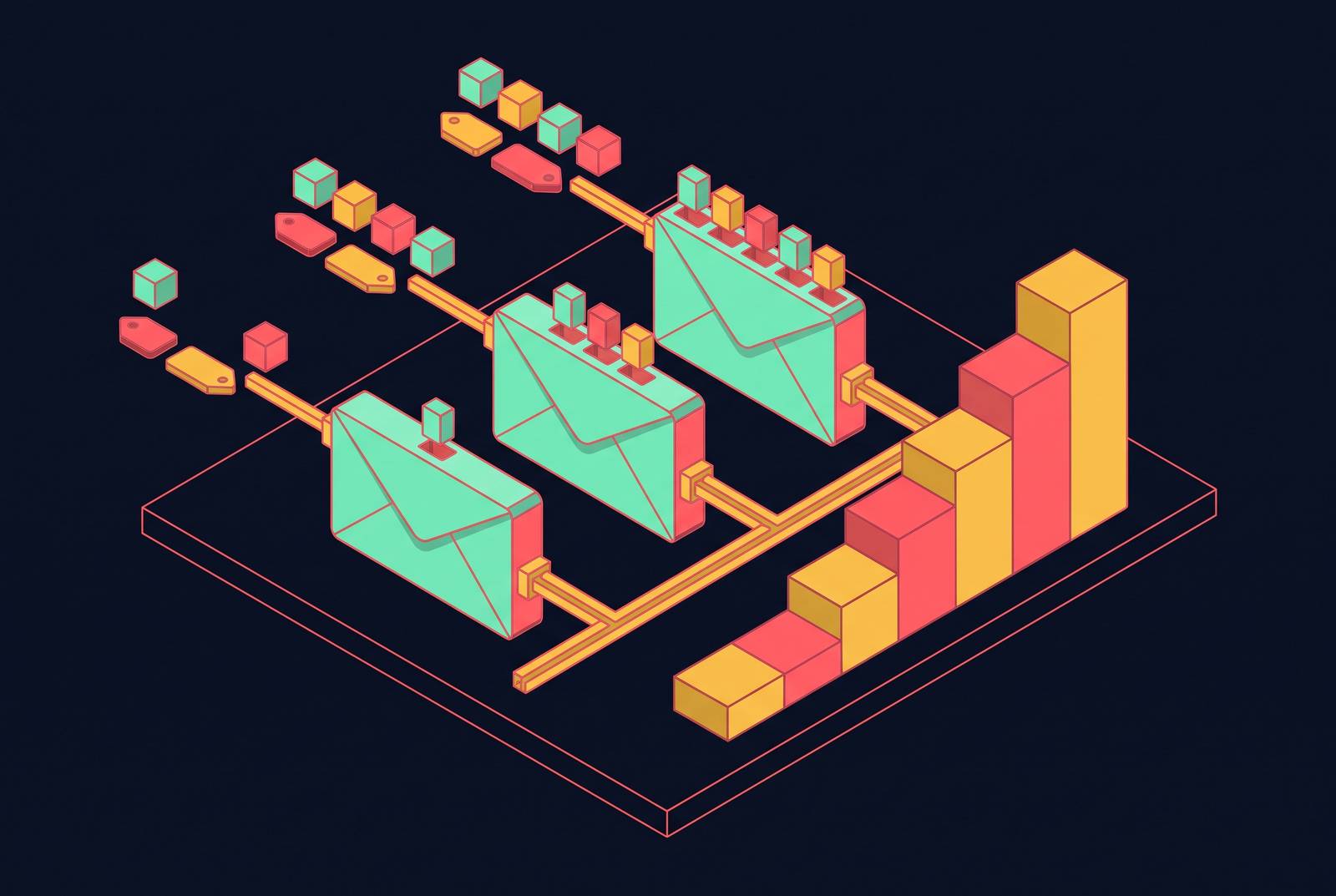
Generic personalization has stopped working because it has stopped being scarce. AI tools now produce passable mail-merge personalization, a first name here, a company name there, at almost no cost and at any volume a rep wants, and that has erased the advantage such personalization used to offer. Instantly's 2026 Cold Email Benchmark Report, cited in LeadHaste's 2026 outbound benchmarks as the most complete dataset available, tracked billions of interactions across thousands of active workspaces between January 1 and December 18, 2025, and found the platform-wide average reply rate is in the low single digits. Saleshandy's separate analysis of 53 million cold emails sent between January and June 2026 found the same thing: an average reply rate in the low single digits, with the top campaigns reaching several multiples above that average. The gap between the average sender and the best sender is the real story in both datasets, and it is not explained by who sends more email or who follows up more often. What separates the top campaigns is specificity of context and timing: you reach a prospect at the moment they show actual buying intent, not on a fixed send schedule. AI made ordinary personalization a commodity, so the competitive edge in outbound has moved upstream to the quality of the signal behind the message.
What reply rate data shows about personalization depth
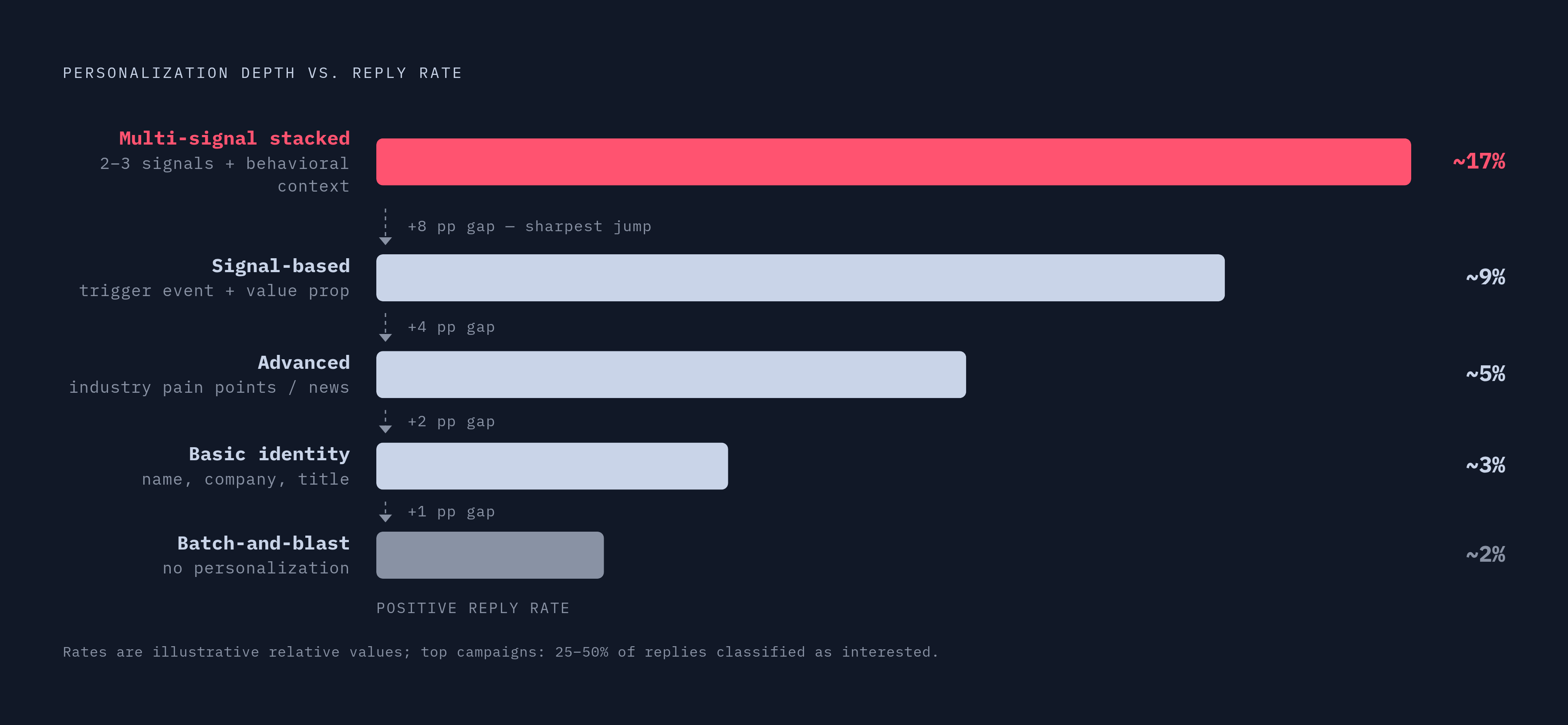
Personalization is not a single feature a sequence either has or lacks. The data from both Saleshandy and HireEmma describes something closer to a ladder, where each added layer of depth produces a measurably different reply rate, and the gain from the bottom rung to the top arrives in a steep jump. Batch-and-blast email with no personalization sits at the bottom of that ladder. Adding basic identity fields, a first name, a company name, a job title, lifts the result modestly but leaves the fundamental dynamic in place, because a prospect can tell within a sentence that the message was built from a spreadsheet column, with no attention paid to them specifically. Advanced personalization moves the needle further when it references an industry-specific pain point or a piece of recent news about the company, because then you can tell the sender actually looked at the account. The real separation happens at the top two rungs: signal-based personalization, where the email is built around a specific trigger event and a value proposition tailored to it, and multi-signal stacked outreach, where two or three signals are layered together with behavioral context. Saleshandy's 53-million-email dataset isolates this using positive reply rate, meaning interested replies divided by total emails delivered, rather than raw reply rate, which lumps genuine interest together with auto-replies and unsubscribe requests and so overstates the value of shallow personalization. By that stricter measure, the dataset found that among the strongest campaigns, something between a quarter and half of all replies came back classified as interested, a signal that high-depth personalization does not just produce more replies, it produces better ones. HireEmma's 2026 outbound sequence benchmarks confirm the same pattern from a different angle: smaller, tightly targeted lists consistently beat broad blasts on reply rate, because precision compounds in a way that volume cannot replicate. Each rung outperforms the one below it, and the distance between rungs widens as the signal gets sharper, which is the structural fact that matters more than any single percentage from either dataset.
The three categories of signal that trigger replies
If depth is what the data rewards, you can ask what a high-depth signal looks like in practice, and the answer sorts into three distinct categories, each working through its own mechanism. First-party behavioral signals come directly from a prospect's own actions: visiting a pricing page, opening a previous email multiple times, attending a webinar, downloading a specific resource. These signals matter because they tell a rep that someone is interested right now, in real time, which makes the window for outreach genuinely short. Third-party intent signals work differently: research activity spread across the broader web, visits to review sites like G2 or TrustRadius, consumption of content on publisher sites not owned by the vendor. Autobound notes that platforms such as 6sense and Bombora aggregate this category of data, and what it reveals is an account already moving through an active buying cycle before anyone at that account has reached out to a seller directly. Trigger-event signals form the third category: a funding round, a new executive hire, a merger, an expansion into a new office or region. These do not indicate that a specific person is shopping for a specific product. They show that something has changed in the organization's structure or budget, so a purchase decision now looks plausible. The three mechanisms are distinct and complementary: first-party signals say someone is interested now, third-party signals say a category-level conversation is already happening inside the account, and trigger events say the organizational conditions for a decision have shifted. If you stack all three, the multi-signal approach at the top of the depth ladder, you get the top-tier reply rates in the Saleshandy and HireEmma data, because each signal confirms and sharpens the other two instead of just adding another data point to a profile.
How to write a signal-based opening line that converts
Everything the signal taxonomy makes possible depends on a single line of copy, the opening line of the email, and that decision turns on a distinction that is easy to state and hard to execute. A real signal reference names the event, names when it happened, and draws out what it implies for the specific person reading it. A hollow signal reference names only the category, something like noting that a company recently raised funding, but it shows no grasp of what that funding round means for the recipient's job. Autobound's framework states the bar: the recipient needs to think that the sender actually did the homework, and anything short of that gets ignored the same way a mail-merge email gets ignored. That bar also requires tailoring by role, not just by event. A VP of Sales reading about a competitor's funding round wants to know about pipeline velocity and how fast the market is moving. A CTO reading about the same event wants to know about integration complexity and technical risk. The underlying trigger can be identical across two prospects at the same company, a new hire, a funding announcement, but the opening line has to be framed differently for each, because the two roles measure consequence differently. Saleshandy's guidance reflects this directly: it tells reps to micro-segment prospects and build separate sequences for each buyer persona before a single line of copy gets written, so a VP of Sales and a Sales Manager at the same account get two different opening lines built on the same underlying trigger, not one generic version sent to both.
Email length, CTA structure, and the other format variables that compound signal-based lift
A sharp opening line does not survive contact with a bloated email. The format around the signal reference either protects the advantage that line creates or wastes it; format has to be treated as part of the signal strategy, not a separate layer of optimization. Discipline around the call to action matters: an email that asks for a demo, a reply, and a calendar booking all in the same message spreads the prospect's attention across three asks and lowers the odds that any one of them gets taken. If a signal-based email has already earned a prospect's attention, it should spend that attention converting it into one specific, low-friction ask, not a menu of options. LeadHaste's 2026 benchmarks, citing data from Gong, show that emails leading with value and requesting a low-commitment response consistently beat pitchy, ROI-heavy email that leads with the product. That finding has a direct consequence for signal-based email specifically: a message that opens with a sharp, well-researched trigger reference and then pivots immediately into a product pitch spends down the goodwill that opening just built. The structure that holds up across the primary sources follows a consistent sequence: open on the signal, naming the specific event and when it happened; connect that event to what the prospect's role makes them likely to care about; offer one narrow, relevant observation of value; close with a single low-friction ask. That sequence runs short by design because every sentence in it is doing a job, and a 300-word, pitch-heavy email built around a genuinely strong opening line still wastes the signal it opened with.
How follow-up timing and sequence structure preserve signal relevance
A signal-based first email that gets no reply has not failed, and the signal behind it has not expired. Whether the sequence builds on that signal or quietly abandons it for generic persistence depends on what happens next. HireEmma's 2026 sequence benchmarks draw on the largest dataset currently available, and they put four to seven total emails as the effective range for a sequence, with the first two steps carrying most of the weight. If you add emails beyond seven without sharpening the targeting or changing the angle, you get diminishing returns, not more replies. Timing matters as much as count. A widening-gap cadence starts with tight spacing between the first touches and stretches the interval as the sequence goes on, so it mimics a real person following up rather than a script running on a timer, and it avoids the evenly spaced pattern that spam filters are built to catch. Saleshandy's 2026 research found a related timing effect: following up the next day actually reduces reply rates, while waiting about three days before the first follow-up increases them, a finding that argues against the instinct to chase a non-response too quickly. Each follow-up also needs its own job to do beyond restating the first email's pitch. HireEmma's structure assigns each step a distinct function: social proof at one stage, a different framing of the same problem at another, a relevant case study, and eventually a breakup email that gives the prospect a clean, low-pressure way to opt out. When the first email was built on a trigger event, that thread needs to carry through the later touches, a follow-up referencing what typically happens in the months following a funding round for a company in that specific space, for instance, rather than abandoning the signal for a generic pitch once the first message fails to land. This is the line that separates a genuine signal-based sequence from a signal-based opener followed by an ordinary drip: a sequence stops the moment a prospect replies, where a drip campaign runs until the recipient unsubscribes. That distinction is not cosmetic. Signal-based follow-up only works if the sequence is built to recognize and respond to engagement rather than continuing to fire on a fixed schedule regardless of what the prospect does.
Multichannel sequencing as a signal amplifier, not a volume play
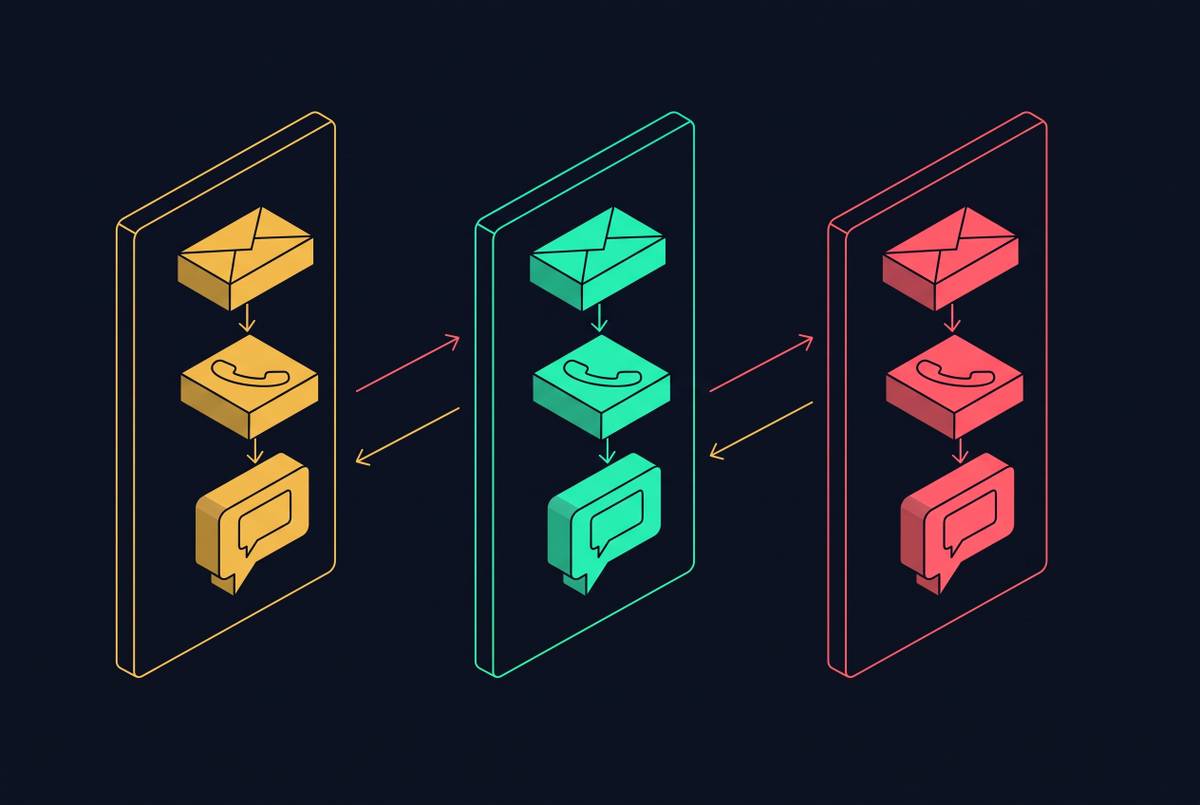
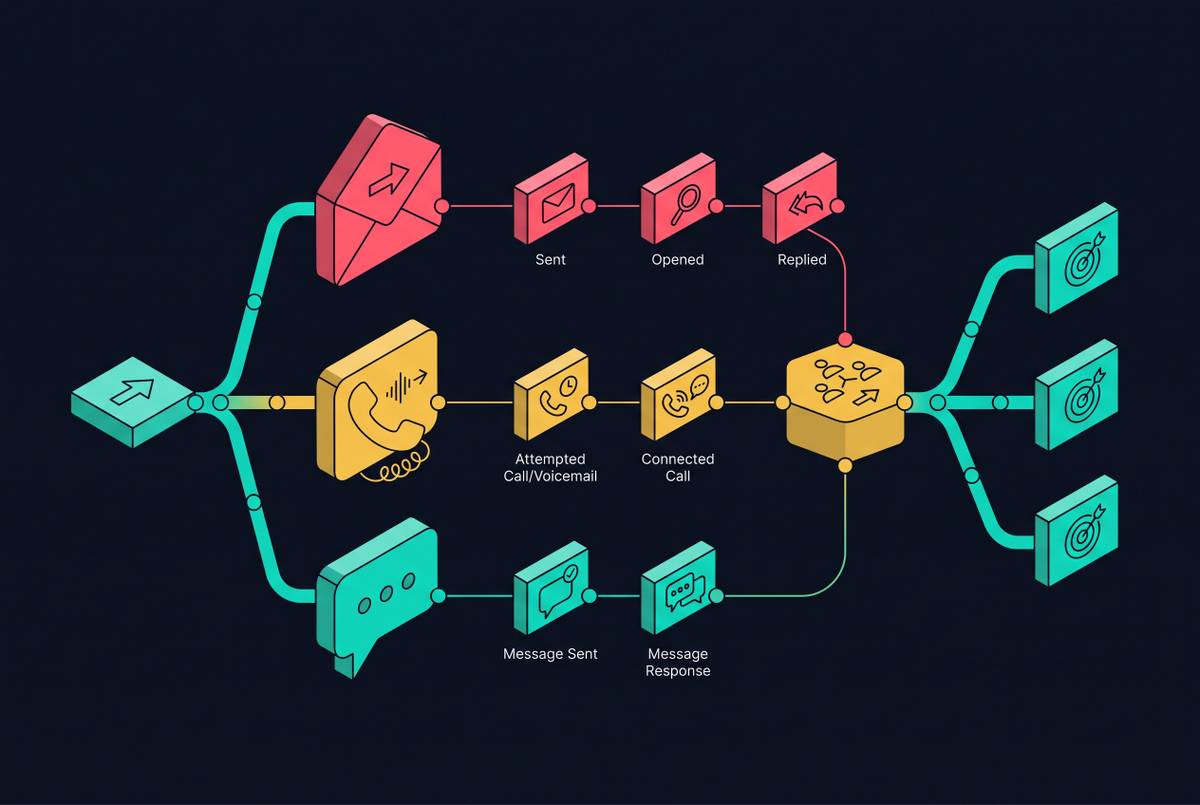
When added LinkedIn and phone touches reinforce the same signal the email is built around, they raise reply rates most; they do less when you fire them off as separate, parallel attempts to reach the same person through more channels. Overloop's 2026 benchmark hub tracks cold email, LinkedIn outreach, and AI prospecting as three separate datasets, and its findings point the same direction: the strongest results come from running email and LinkedIn against the same prospect list on a shared timeline, so a prospect who ignores one channel still gets a second, coordinated chance through the other. LinkedIn carries a mechanism of its own worth understanding here. Viewing a prospect's profile ahead of outreach is itself a visible signal to that prospect, so if you engage with something they posted before you send a message, a later reference to their recent post or announcement reads as earned attention, not something scraped off a dashboard. Direct mail plays a narrower role in this architecture. Autobound notes that a handwritten note, or a relevant book sent after the second email touchpoint, can cut through digital noise for enterprise accounts that justify the cost, but that tactic belongs with high-value targets specifically, not as something deployed at volume across a list. Running multiple channels adds operational complexity, and a prospect who gets hit on email, LinkedIn, and phone in the same week with no apparent coordination experiences that as harassment. The answer to that objection is sequencing discipline, not fewer channels. Email, then LinkedIn, then phone, run deliberately rather than simultaneously, with one signal thread connecting all three touches, gives each one a coherent reason to exist instead of treating the prospect as a target to be hit repeatedly from as many directions as possible.
How AI fits into signal-based personalization
AI created the problem this entire argument is built on, flooding inboxes with cheap, passable personalization, but AI is also the only realistic way you can run a signal-based program at any scale beyond a handful of accounts a rep can research by hand. Resolving that tension comes down to dividing the labor correctly: AI handles signal detection and first-draft generation, and a human preserves the judgment and specificity that make a signal reference actually land. A Saleshandy A/B test across 12,000 sends compared AI-only, human-only, and hybrid approaches, where hybrid meant an AI-generated draft followed by human editing, and found the hybrid approach produced the highest reply rates of the three. The AI draft does the work of scaling research and producing a first pass quickly; the human edit keeps the message sincere and specific, guarding against generic content in a new disguise. The AI-only approach carries a deliverability problem on top of a quality problem: AI-only sends get flagged as spam at a meaningfully higher rate than human-written email sent through the same infrastructure. There is an academic basis for why recipients can tell the difference even when the writing itself reads cleanly. A study from the University of Florida and the University of Southern California found that professionals rate heavily AI-written messages as sincere far less often than messages that show only light AI assistance, which suggests that once a reader senses heavy AI authorship, they start questioning the sender's effort and judgment, not just the quality of the sentences. The legitimate use of AI in this process looks specific rather than general: tools like Autobound surface company-level signals automatically, funding events, M&A activity, earnings calls, leadership changes, new office locations, and generate a draft built around them, with a human editor checking that the signal reference is accurate and that the framing actually fits the recipient's role. Overloop's 2026 AI prospecting benchmark report frames the stakes in similar terms: it tracks whether a given sales team's stack and reply rates keep pace with teams already running AI-assisted outbound, and it treats AI personalization as a multiplier on a well-targeted list, not a substitute for the targeting itself. The practical instruction that falls out of all of this is to use AI to find which accounts have actually fired a relevant signal, generate a draft that names that signal and ties it to a value observation specific to the recipient's role, then edit the opening line by hand so it names a specific, verifiable event. That last edit is the step most AI-only workflows skip, and it accounts for most of the reply-rate gap between the teams still sending generic AI output and the teams running a genuine signal-based program.