Sequencing Tool Comparison for Outbound Sales Teams
Platforms now split by what they're built for, not just features.
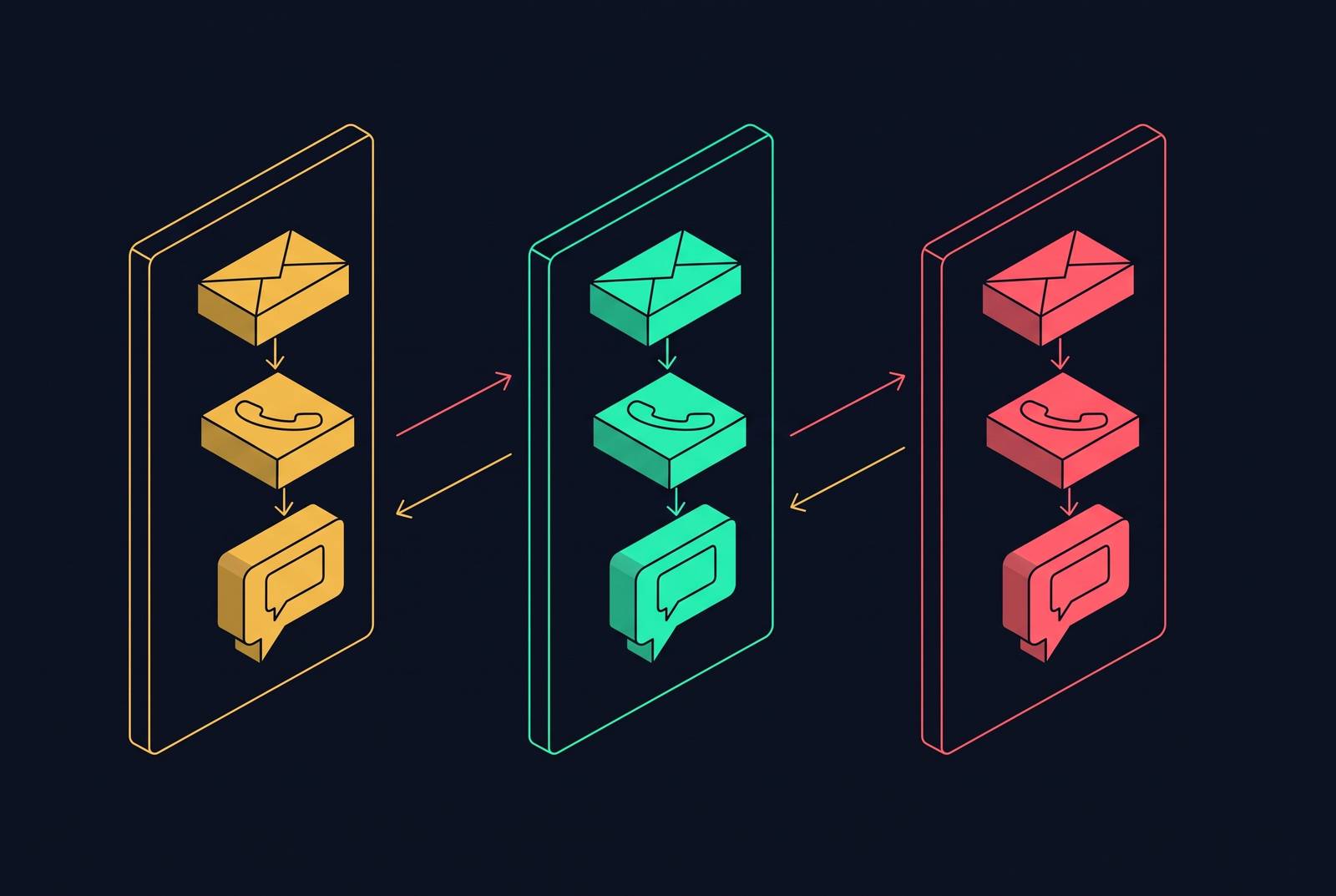
Outbound sequencing software split into separate tiers by 2026, and that split makes a single ranked list the wrong way to shop for one. The category used to answer one question: how do you send email at scale? It now has to answer a harder one, covering what should happen around the sending, including data sourcing, buying signals, multichannel orchestration, deliverability, and CRM writeback, and no single platform leads on every one of those fronts at once.
AI personalization, multichannel reach across email, phone, and LinkedIn, signal-triggered entry logic, and built-in contact data all became baseline expectations rather than features that set one tool apart from another. Every vendor still had to place a bet on which of those capabilities to build deepest, because none could lead on all of them. A team that picks the highest-rated tool on a review site without checking which bet that tool made ends up with a capability mismatch, and that mismatch costs pipeline, not just a subscription fee. The fix is to sort the market into tiers by the job each tool is actually built to do, then pick the tier that matches the team's motion before comparing products inside it.
What a sequencing tool does
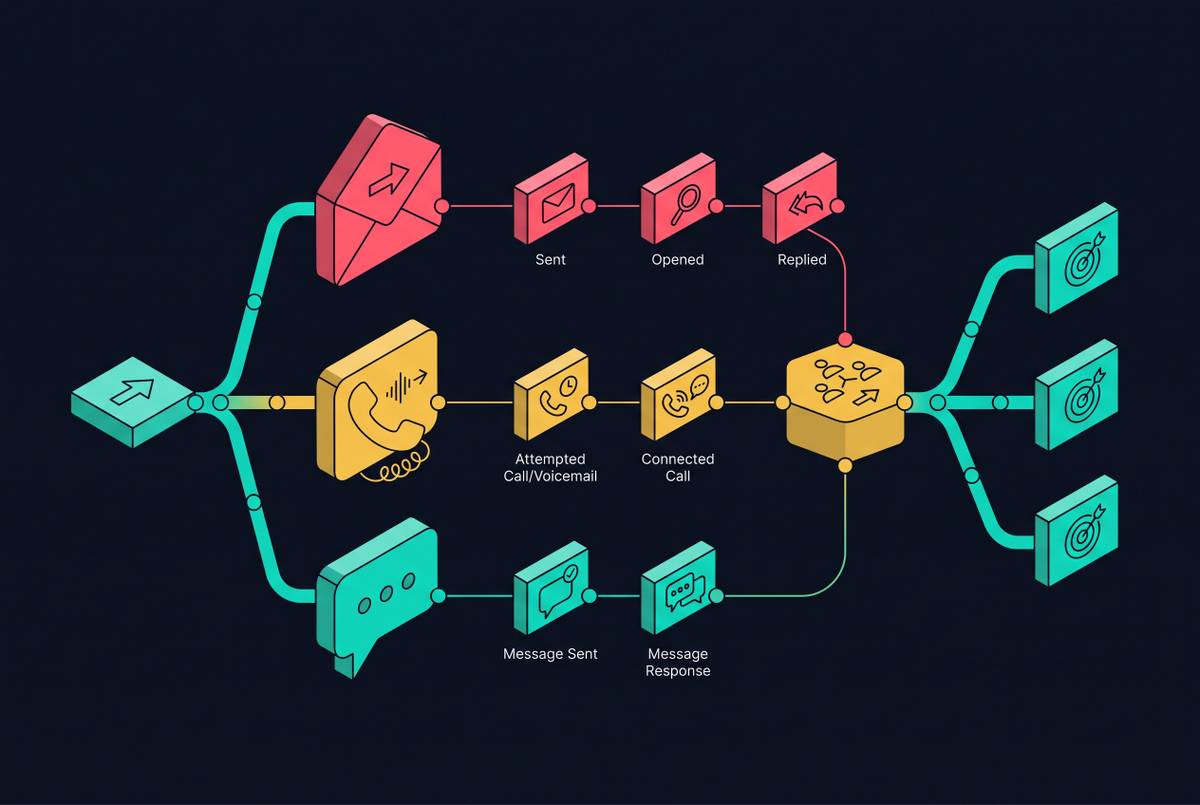
A sequence is a structured series of outreach steps, a cold email, a follow-up, a LinkedIn message, a call task, delivered on a schedule to move a prospect toward a conversation. A workflow sits around that sequence and makes decisions: when the sequence should start, which trigger set it off, what path a lead takes based on how they respond, and what happens after they engage, including CRM updates and task creation. Most vendors now call their sequences "workflows" in marketing copy, but a sequence sending on a timer and a workflow reacting to a real-world signal are different things built on different engineering, and that difference is where platforms actually pull apart from each other.
Five capabilities separate the platforms that have built genuine orchestration from the ones that have renamed their sequencer. The first is signal-triggered entry: can a lead enter a sequence because something happened, a pricing page visit, a funding round, a job change, rather than because a rep manually added them to a list? The second is mid-workflow branching: does the sequence adjust when someone clicks a link but doesn't reply, or route differently depending on what the CRM says about that account? The third is multichannel depth, meaning whether email, phone, and LinkedIn share one sequence and one reply state or live in separate tools that don't talk to each other. The fourth is account-level coordination, the ability to act on every contact at an account once one of them shows intent. The fifth is post-engagement automation: whether CRM writeback, task creation, and list management run as built-in steps in the workflow or get left to a rep to handle by hand afterward. A platform can do the first of these well and the last one poorly, and the tier it belongs in follows from that pattern, not from its marketing page.
The four tiers
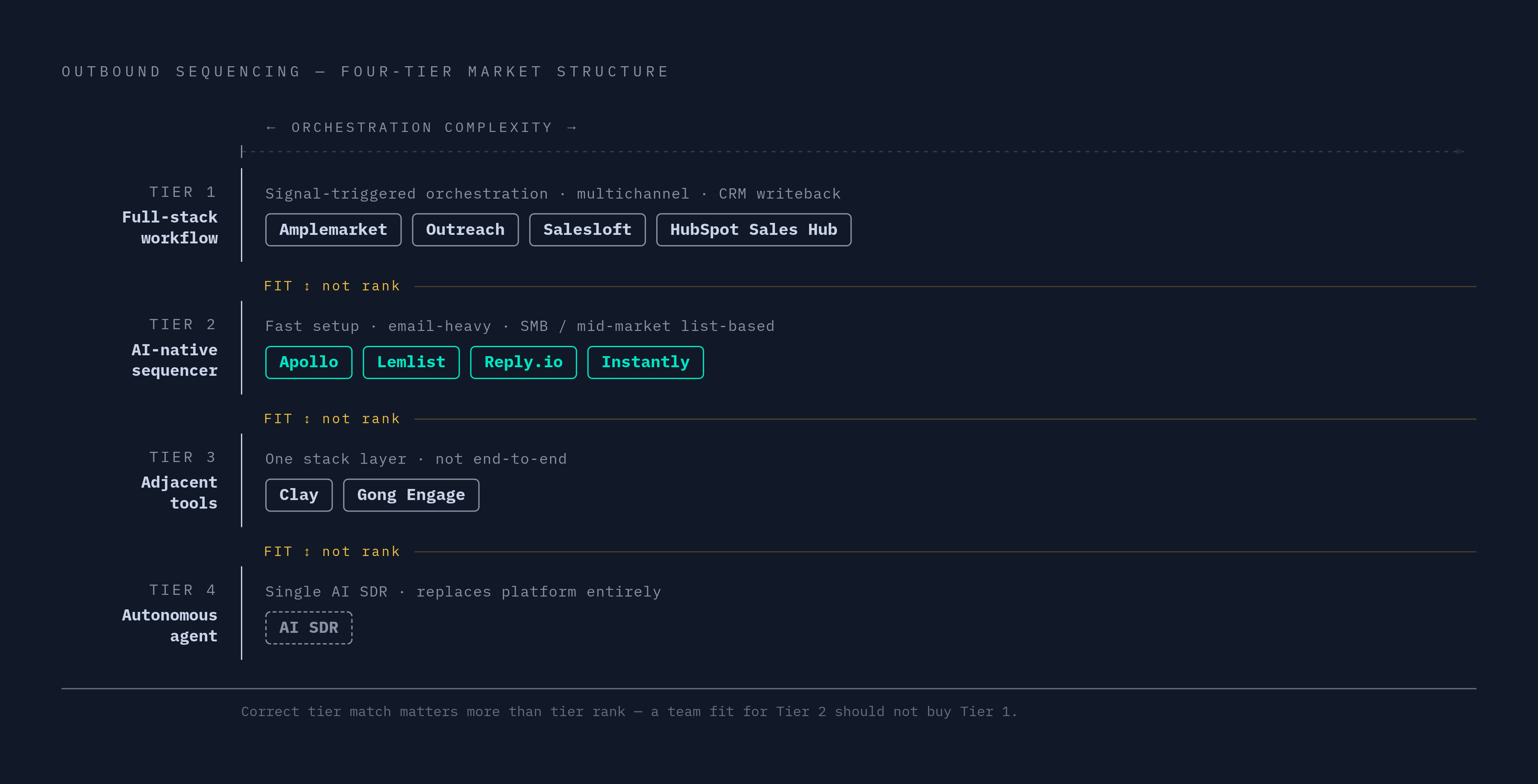
The market has settled into four tiers, each organized around a different job-to-be-done, and a workflow orchestration analysis of ten platforms is what produced this structure. Picking the wrong tier creates friction no feature list fixes, because the problem isn't a missing button, it's an architecture built for a different kind of outbound motion than the one the team runs.
The first tier is full-stack workflow platforms: Amplemarket, Outreach, Salesloft, and HubSpot Sales Hub, each combining data, sending, signals, deliverability, and workflow orchestration into one system for teams that want the entire outbound motion to live in a single platform. The second tier is AI-native sequencers: Apollo, Lemlist, and Reply.io, fast to set up, strong on personalization and deliverability, built for an email-heavy motion at SMB and mid-market scale, with lighter orchestration depth than the first tier. The third tier covers adjacent tools, Clay for data orchestration and Gong Engage for conversation intelligence expanding into engagement, and these solve one specific part of the stack rather than end-to-end execution, so they work best layered in front of a separate sending platform. The fourth tier is autonomous agents. A team deploys one as a single AI SDR instead of a platform reps configure and run themselves, and that is a distinct architectural choice with its own tradeoffs.
None of this ranks the tiers against each other. A team running list-based outbound with one rep and no signal requirements isn't underserved by a tier-two sequencer, it's correctly matched to one, and buying into tier one in that situation means paying for orchestration capacity nobody on the team will use. Three questions place a team in the right tier: what the primary outbound channel is, how much of the stack needs to live in one tool versus several connected ones, and whether the motion depends on signal-triggered entry or runs fine on list-based outbound. The sections below walk through each tier in order, and you start with the one built for the heaviest orchestration load.
Tier one: full-stack workflow platforms, starting with Amplemarket
The cost of a missing workflow layer is the interested reply that sits unanswered for three days, the account that goes quiet after a demo and never gets re-engaged, the signal that fires and nobody acts on it because no system was watching for it. Full-stack platforms exist to close that gap, but they earn their price premium only when a team genuinely needs signal-triggered orchestration, multichannel coordination, and CRM writeback running as one connected system, not three disconnected tools stitched together by a rep's memory.
Amplemarket is built around that requirement directly. It combines a native B2B contact database, engagement across seven channels, buying signal intelligence, deliverability infrastructure, and a workflow automation layer in one platform. The automation layer runs on four parts: Triggers, Filters, Paths, and Actions, with native triggers that include a contact or account being created or updated, a sequence starting or finishing without a reply, a meeting getting booked, an email bouncing or getting a reply, and a social connection or reply coming in on LinkedIn. In the five-capability workflow orchestration evaluation covering signal-triggered entry, mid-workflow branching, multichannel coordination, account-level targeting, and post-engagement automation, Amplemarket scored highest among the platforms assessed. Pricing starts at several hundred dollars a month on an annual term, and two users are included. The platform fits mid-market to enterprise teams that prioritize outreach built around buying signals, where the cost of a dropped ball outweighs the cost of the subscription. It isn't the right starting point for a very small team or founder-led sales running on low volume, where the price floor outruns what the motion needs.
Outreach serves a different buyer inside the same tier: large sales organizations that need cadence execution tied directly to deal management and revenue forecasting. Its AI features lean toward pipeline visibility, deal risk signals, and sentiment analysis rather than workflow breadth, so it leads on conversation intelligence depth but not on orchestration. Running it well takes RevOps support, and it's designed for organizations with 50 or more reps that need controlled cadence governance across a large team. A common complaint centers on slow product iteration and a total cost of ownership that climbs once data and deliverability get bolted on separately.
Salesloft now operates under a single brand after completing its merger with Clari on December 3, 2025, combining Clari's forecasting and pipeline intelligence with Salesloft's sales engagement and conversation intelligence under CEO Steve Cox. The combined company serves thousands of customers, and Salesloft is now the company and platform brand going forward, with only the forecasting product keeping the Clari name. As of mid-2026, the integration is still in progress: the interfaces remain separate, there's no published unified product roadmap even though several integration milestones had shipped by that point, and pricing has moved upward for teams that want the bundled experience. The merger opens the door to a combined engagement-and-forecasting motion, with new deals increasingly bundling Salesloft alongside Clari's forecasting stack under a "Predictive Revenue System" pitch, but it also adds roadmap uncertainty and cross-sell complexity for a buyer who only wants sequencing. In August 2025, Salesloft disclosed a cybersecurity incident involving its Drift platform, and this was later found to be far more widespread, potentially compromising over 700 organizations. If you're evaluating Salesloft, you should check its current security posture directly before you sign. Its pricing isn't a fit for teams that want sequencing alone without the forecasting bundle attached.
HubSpot Sales Hub fits a team already running its business inside the HubSpot CRM, where the CRM is the center of gravity and switching away from it carries real cost. Its sequence builder works but sits lighter than the other three platforms in this tier, with complex multichannel orchestration, advanced AI workflows, signal-based prospecting, and deep outbound automation outside its strengths. Its advantage is native CRM depth and how easily a HubSpot-native team can adopt it, and you can find pricing published per seat in tiers on HubSpot's own site. Across all four options in this tier, the fit question comes down to one thing: full-stack platforms make sense when orchestration complexity, not sending volume, is the actual constraint a team is working against.
Tier two: AI-native sequencers for teams with a focused outbound motion
If your outbound motion runs mostly through email, doesn't depend on signal triggers, and needs to launch fast, you can get strong results from an AI-native sequencer for a fraction of what a full-stack platform costs. The tradeoff shows up as lost reach or lost precision depending on which capability the cheaper tool cut, and that's what buyers should weigh against the sticker price.
Apollo.io bundles a contact database running into the hundreds of millions of records with built-in sequencing, a dialer, and native CRM functionality, giving it the widest single license in this tier. A five-person SDR team can prospect, sequence, call, and manage its pipeline without leaving the platform. What it doesn't match is the depth of enterprise forecasting and revenue intelligence found in other full-stack platforms, and data accuracy varies once a team prospects outside its core coverage region, with the more advanced features locked behind higher-tier plans. It carries strong ratings on G2 and shows up often as the all-in-one starting point for a growing team.
Lemlist covers email, LinkedIn, and call sequences and tends to get picked for creative, personalized campaigns at SMB scale, with multichannel plans billed annually. Its strength is personalization depth combined with multichannel coordination inside a single workflow, backed by a native contact database in the hundreds of millions with email and phone enrichment built in.
Reply.io covers email, phone, LinkedIn, SMS, and WhatsApp at a mid-market price, starting around $49 per user per month, and integrates with Salesforce, HubSpot, and Pipedrive. It includes an AI SDR agent called Jason AI and intent signals as a separate add-on plan. It fits a team that wants multichannel breadth without paying enterprise prices more than it fits a team that needs deep orchestration or its own native data.
Instantly is the most narrowly focused tool in the tier: high-volume cold email at minimal cost, built around inbox rotation, warmup, and deliverability optimization. That deliverability focus is what earns it a place here despite being email-only, because inbox rotation and warmup solve the specific problem of keeping cold email out of spam folders at volume, a problem the other three tools in this tier treat as secondary. Its Growth plan starts at a discounted rate when billed annually. It doesn't include built-in prospecting data and doesn't touch phone or LinkedIn, so if your real bottleneck is email volume and deliverability, you source your contact data somewhere else.
Across this tier, the shared tradeoff is lighter workflow orchestration, native signal triggers that are either missing or limited, and post-engagement automation that doesn't go very deep. Those are acceptable costs for a team running list-based outbound rather than signal-triggered account-based marketing, and that is exactly the motion this tier is built for.
Tier three: adjacent tools that strengthen the stack without replacing it
Clay and Gong Engage each solve a real, specific problem inside the outbound stack, but neither one is a sequencer, so if you treat either as a sequencer replacement, you leave a gap another tool has to fill.
Clay is built for revenue operations teams and growth engineers who want direct control over their outbound data workflows. It sources contact data from a wide range of providers, applies AI-powered waterfall enrichment across those sources, and then outputs enriched lists or triggers into a separate sending platform. A free plan is available, and the Launch tier costs $167 a month when billed annually. It works best as the data orchestration layer feeding into Amplemarket, Apollo, Instantly, or another sequencer, not as a standalone tool for sending outreach. Configuring it takes technical comfort, so it isn't the right tool for an SDR who needs something they can run alone without RevOps backing them up.
Gong Engage takes a different route into the same tier, adding sequencing on top of Gong's existing conversation intelligence. If a team already uses Gong's call analytics, it can extend that context directly into outbound engagement, so what it knows about its calls turns into action inside the same system. Both tools belong in the stack as a layer, not as the foundation, and a team that understands that distinction gets the most value out of either one.