Waterfall Enrichment Providers Compared: Clay, SyncGTM, Instantly and Others

A single data provider, no matter how large its database, leaves 40 to 60 percent of qualified prospects unreachable. That's not a rounding error. A pipeline that converts and one that quietly starves are separated by this. The reason lies in structural limits no single vendor controls. It's structural: no provider observes the whole market, and the portion of the market it does observe is already decaying by the time you query it. B2B contact data ages at roughly 30 percent a year, driven by role changes, company moves, and domain churn. A static enrichment run is stale before the sales team even opens the spreadsheet.
Waterfall enrichment exists to close that gap. The mechanic is simple to describe even if the engineering behind it isn't: query Provider A, and if it misses, move to Provider B, then Provider C, stopping the moment one of them returns a verified match. Each additional provider in the sequence catches what the one before it missed, and because providers build their databases from different sources (some scrape, some rely on user-submitted data, some partner with data brokers), their gaps rarely overlap perfectly. Stacking enough of them in the right order compounds coverage. GTM teams that adopt waterfall enrichment consistently report 20 to 40 percent higher hit rates than any single-source tool delivers on its own.
The category has also changed shape. Enrichment used to mean exporting a list, running it through a batch tool, and re-importing a CSV a day or two later. As of 2026, that workflow has largely given way to real-time, in-CRM waterfall lookups that run continuously across the pipeline. Once a team accepts that no single source will get them there, the only question left is which multi-provider architecture to build on, and that's a question with more moving parts than most buyers expect.
Four dimensions that drive selection across waterfall platforms
The marketing language across this category converges on the same claim: more providers, better data. That's only half true, and treating it as gospel is how teams overpay for coverage they don't need or underbuy coverage they do. Four dimensions actually separate these platforms, and none of them is "how many logos are on the homepage."
Provider depth is the first, and it's the one buyers fixate on, sometimes to their own detriment. A waterfall built on five redundant sources burns credits without adding coverage; a waterfall built on five uncorrelated sources compounds fast, since a five-provider waterfall sequence costs five separate lookups' worth of credits, not one.
Sequencing logic is the second, and it's more consequential than most feature comparisons suggest. Some platforms run a fixed sequential order set once and left alone. Others allow field-level routing, so email and phone can each have a different provider priority. A newer approach uses AI to route each contact dynamically based on geography, industry, or company size. Each model trades speed, credit consumption, and accuracy differently, and none is universally correct.
Pricing model is the third, and it's where the category hides its real cost. Credit-per-lookup billing charges you whether or not the query succeeds. Credit-per-match billing charges only on a hit. Flat subscriptions abstract the difference away entirely, for better or worse. The architecture of the bill determines how cost scales as volume rises or miss rate climbs, and the two models produce wildly different totals at scale even when the underlying data is identical.
CRM and workflow integration is the fourth. A platform that writes enriched fields directly into HubSpot or Salesforce eliminates the export and import cycle that introduces both latency and failure points; a platform that requires a manual round trip reintroduces the very friction waterfall enrichment was supposed to remove.
SyncGTM: waterfall-native architecture with 50+ providers in a single workflow step
SyncGTM was built around the waterfall model rather than having one bolted on.
The logic runs at the field level. If Provider A returns a verified email but misses the phone number, Provider B fills the phone field, and Provider C adds technographic data, each field carrying its own provider priority sequence. In a controlled test of 1,000 contacts, that approach delivered 35 percent higher coverage than any single-source tool tested against it. A separate test run through Claude Code using SyncGTM's MCP integration pushed email coverage to 85 to 92 percent, against 50 to 65 percent from a single provider working the same list. Firmographic data, pulled from business registries, financial databases, and web-scraped sources, is in the 90 to 95 percent range for US and EU companies, though coverage thins out in emerging markets where those underlying registries are sparser.
Native CRM sync covers HubSpot, Salesforce, Pipedrive, Attio, and Zoho. Pricing starts with a free tier at 200 credits, with a Solo tier at $49 a month, Growth at $99, Pro at $249, and Business at $649. That said, credit consumption is still a live operational concern even inside a single-step architecture: a badly ordered field sequence can burn through providers unnecessarily, and teams still have to watch where their credits go. SyncGTM is also younger than the incumbents in this category, with a smaller user community to draw troubleshooting knowledge from, and its more advanced workflows carry a real learning curve. Engine queries 50+ data providers in sequence (Apollo, Hunter, RocketReach, Findymail, Datagma, PDL, and others) behind a single API, requiring no manual provider chaining.
Clay: maximum provider breadth and custom waterfall logic, with real complexity costs
Clay is the platform most often cited when this category comes up, and the reason is straightforward: it offers more than 150 data providers, with waterfall sequencing configured independently per field. Email might cascade through Apollo, Hunter, Dropcontact, and Findymail in that order, while phone runs an entirely separate provider sequence. Claygent, Clay's AI research agent, can browse the web autonomously to compile company and contact detail that no structured provider carries, and it's available even on the free tier.
That free tier includes 100 data credits and 500 actions a month, unlimited seats and tables, a 200-row cap per table, and no phone enrichment. The Launch plan, at $167 a month, adds phone enrichment and job-change signals. Growth, at $495 a month, adds Web Intent on top of everything in the prior Pro tier, and following a March 2026 pricing overhaul, data costs across the platform dropped 50 to 90 percent while failed-lookup charges were eliminated entirely.
The billing mechanics still deserve close attention. A five-provider waterfall sequence costs five separate lookups' worth of credits, not one flat fee. The sticker price and the real spend diverge fast.
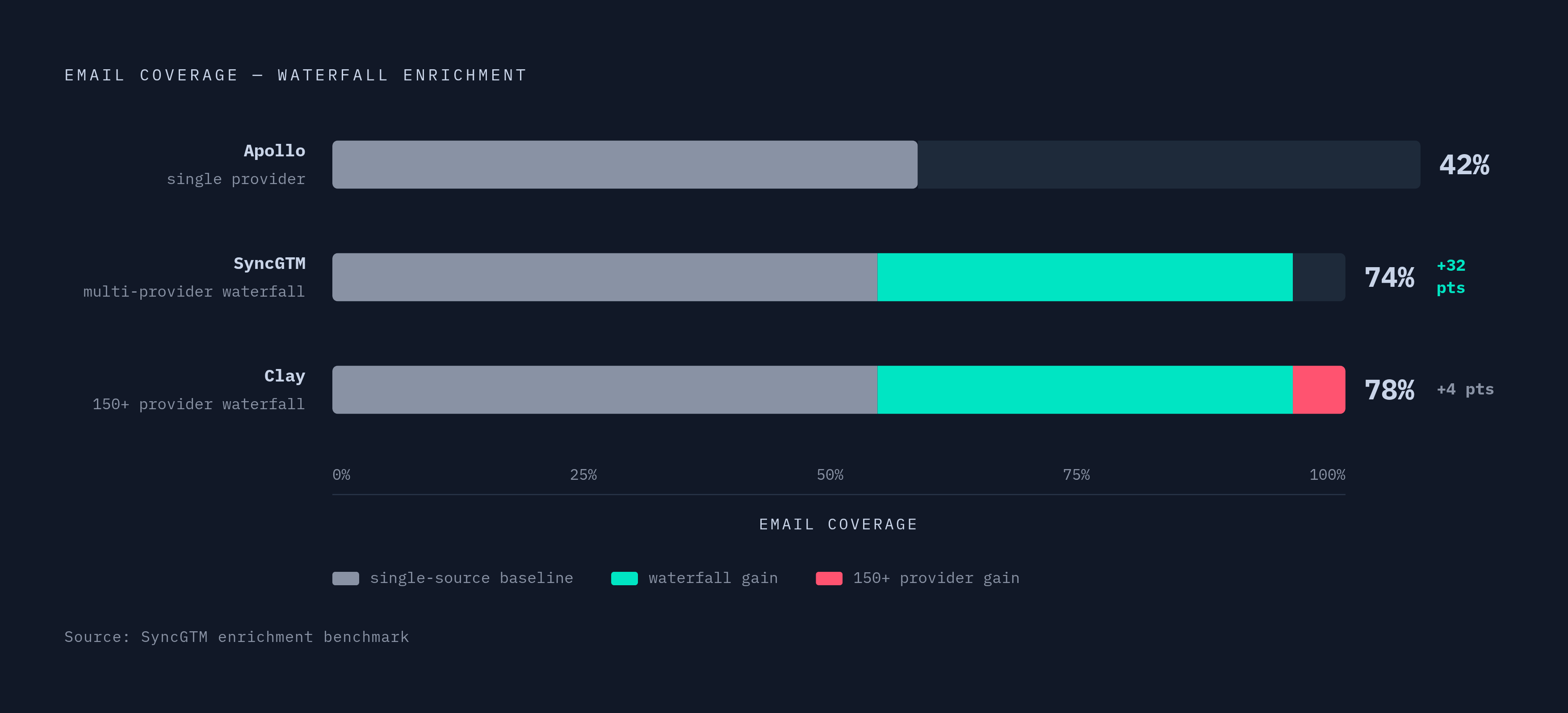
Against that cost, the performance case is real but narrow. On a 500-contact benchmark, Clay's waterfall hit 78 percent email coverage, against 74 percent for SyncGTM and 42 percent for Apollo running standalone. Clay's edge over SyncGTM there is 4 percentage points (78% vs. 74% email coverage), purchased at a $348-a-month cost difference. Whether that trade is worth it depends entirely on how much a marginal point of coverage is worth to the team paying for it. A 231-feature evaluation by Amplemarket scored Clay highest among waterfall platforms on provider depth, a perfect 3 out of 3, but gave it zero on engagement and zero on deliverability, and the platform's true total cost of ownership runs higher than the enrichment line item alone suggests. Cleanlist analysis puts real cost at scale for teams running large enrichment jobs regularly at $800–$3,000+/month depending on volume, with a representative 5-step, 500-contact workflow running roughly $325–$600 total, or approximately $0.65–$1.20 per contact on Growth. The company is funded at a $3.1B valuation and counts OpenAI and Anthropic as customers.
FullEnrich: pay-per-match pricing for high-volume outbound teams
FullEnrich, a French B2B contact enrichment platform launched in 2023, takes a different approach to the same problem, querying more than 15 third-party providers, among them Apollo, Dropcontact, Hunter, Datagma, Findymail, RocketReach, and BetterContact, in sequence for each contact. The provider list overlaps meaningfully with Clay's and SyncGTM's.
FullEnrich charges one credit per successful match, full stop, regardless of how many providers the waterfall had to burn through to get there. A work email costs one credit, a mobile number costs ten, a personal email costs three, and unused credits roll over for three months on monthly plans. No credits are spent on misses. That single design choice changes how a team behaves operationally: instead of rationing lookups out of fear that a failed query still costs money, teams can run enrichment more aggressively and refresh lists more often, since the cost structure only ever charges for what actually lands. Where standalone single-source tools typically match 50 to 60 percent of a list, FullEnrich's waterfall routinely lifts that to 75 to 90 percent, with an average find rate around 80 percent.
Pricing starts at $29 a month for the Starter tier and $55 for Pro, and Pro and above let teams configure provider order directly, putting Dropcontact first, for instance, when GDPR-defensible sourcing takes priority over raw speed. Credits are unlimited across users and shared at the workspace level. Phone enrichment is a genuinely strong part of the product as of 2026, which matters given how many providers in this category treat mobile numbers as an afterthought.
The trade-off is scope. FullEnrich enriches records; it doesn't send anything. There's no native outreach layer, no sequence builder, no cadence management, so a team adopting it still needs a separate tool to actually run campaigns. It also carries no buying-signal detection of any kind: no hiring-surge alerts, no funding notifications, no tech-stack change monitoring. Teams that want that layer of signal intelligence are choosing a different category of tool, or stacking one on top.
BetterContact: AI-routed waterfall and the strongest phone enrichment in the category
BetterContact departs from the fixed-sequence model that defines most of this category. It queries more than 20 providers, but instead of running a static order every time, an AI routing layer evaluates each prospect's geography, industry, and company size and selects the provider most likely to return a valid result first. That's a meaningfully different bet than Clay's or SyncGTM's per-field configuration: rather than a human deciding the sequence in advance, the system adapts the sequence per contact.
The payoff is visible in phone data. BetterContact returns mobile hits at 20 to 35 percent on typical B2B lists, per community benchmarks, a range with no close competitor named in this category. Email performance holds up too, with find rates of 87 to 95 percent on US and UK contacts according to G2 reviewers. Pricing is aggressive: $15 a month for 200 credits, which is the lowest-cost entry point into waterfall enrichment as of 2026, with $49 a month buying 1,000 credits.
BetterContact rarely operates entirely on its own. It shows up as a provider step inside larger workflows, including Instantly's SuperSearch Custom Flow waterfall, where its position in the sequence can be reordered to balance match rate against credit spend. That's a fair description of where BetterContact sits in the market generally: a strong, narrowly scoped component. There's no workflow builder here, no outreach layer, and no signal enrichment, so teams adopt it either as a standalone phone-and-email tool or as one link in a chain built somewhere else.
Instantly.ai: prospecting, waterfall enrichment, and outreach collapsed into one platform
Instantly takes the opposite bet from FullEnrich and BetterContact. Rather than specializing in enrichment depth, it collapses lead discovery, multi-account email infrastructure, deliverability management, AI-powered outreach, a built-in CRM, and website visitor identification into one platform, serving more than 40,000 customers who collectively send 5 million emails a day. Enrichment here is a feature of a larger machine, not the machine itself.
Beyond the core email waterfall, an AI web-research agent scrapes company sites for supplementary detail, and other native AI capabilities surface custom data points no structured provider offers.
Pricing separates the Outreach subscription from Instantly Credits, which fund the AI Sales Agent and waterfall enrichment; the Nano tier runs $42.30 a month. Verification accuracy in testing landed around 85 percent, with the remainder coming back as hard bounces or invalid addresses, meaning list hygiene and ongoing deliverability monitoring stay necessary even inside a consolidated platform. That's the honest caveat to sit with: consolidation doesn't eliminate the need for cleanup, it just moves where the cleanup happens.
The real trade-off is depth against simplicity. Instantly erases the export and import latency that comes from running prospecting and outreach as separate tools, and for a team whose priority is getting from a lead list to a live campaign fast, that's worth real money in time saved. But the waterfall itself, at five-plus providers, simply won't match the coverage ceiling of a dedicated enrichment engine. Teams that care more about outbound execution than about squeezing the last few points of coverage out of a contact list will find that trade acceptable. Teams chasing maximum match rate on a hard list won't. SuperSearch provides 450M+ leads, with waterfall enrichment querying 5+ providers in sequence until a verified email is found, a narrower provider depth than Clay (150+) or SyncGTM (50+). BetterContact is available as a provider step in a Custom Flow waterfall enrichment within SuperSearch, with provider order reorderable.
The rest of the named field: what CompanyEnrich, Apollo, ZoomInfo, and People Data Labs each contribute
CompanyEnrich, at $49 a month, is an API-first platform built for validated company data rather than contact-level detail, distilling a large volume of raw records down to verified company profiles. It fits teams enriching firmographic fields programmatically, not teams chasing individual emails or phone numbers.
Amplemarket's evaluation found Apollo bounce rates of 20–30%, and Apollo is best positioned as a mid-market tool combining prospecting and enrichment in one interface rather than as a pure waterfall engine.
ZoomInfo, at $15,000 or more a year, holds the largest proprietary single database in the category, though Amplemarket's evaluation put its bounce rate at roughly 15 percent or higher. Enterprise buyers also take on meaningfully more compliance and legal procurement overhead at this tier.
People Data Labs, priced at $0.28 per record, is best understood as a data supplier rather than a workflow platform. It carries a very large person-record database and is designed to be layered inside a waterfall stack a team builds elsewhere, not to orchestrate that stack itself.
Matching platform architecture to team type and use case
None of this resolves to a single winner, because the platforms are answering different questions. RevOps teams and growth engineers who can build and maintain their own workflows, want maximum provider flexibility, and can tolerate weeks of onboarding land well on Clay or SyncGTM. Clay offers the broadest provider marketplace available; SyncGTM offers comparable depth with less manual configuration and a meaningfully lower cost floor.
Teams running high volumes of outbound, where an unpredictable miss rate would make credit costs impossible to forecast, are better served by FullEnrich's pay-per-match model, which removes the risk of paying for failed lookups at scale.
Smaller teams and founders who want to prospect, enrich, and launch outbound campaigns from one interface, without assembling and maintaining a multi-tool stack, are the clear fit for Instantly. The architecture that wins isn't the one with the most providers on its homepage. It's the one whose sequencing logic, pricing model, and integration depth match how the team actually operates, day to day, list after list. For teams where phone coverage is the primary enrichment gap, or where AI-directed provider selection is preferred over fixed-sequence logic, BetterContact is available as a standalone or as a component inside a broader stack.