Why Your Enrichment Data Goes Stale Before You Use It
The delay between enriching data and using it costs you more accuracy than months of natural decay.
Enrichment data starts going bad the second it's collected, not months later when someone finally gets around to using it. The lag between the moment a record gets enriched and the moment a rep actually acts on it is long enough that a real chunk of any database is already wrong before that first email goes out. The lag between the moment a record gets enriched and the moment a rep actually acts on it, not the annual decay rate everyone quotes, is long enough that a real chunk of any database is already wrong before that first email goes out. Why Your Enrichment Data Goes Stale Before You Use It
Why the "annual decay rate" framing understates the real problem
The number everyone cites is 2.1% monthly decay compounding to roughly 22.5% a year, and it comes from HubSpot's Database Decay Simulation, built on older MarketingSherpa research HubSpot Database Decay Simulation / MarketingSherpa unifygtm.com Cognism. It's used wrong. It's just used wrong.
That gap between enrichment and outreach is the misread. The gap between enrichment and outreach is the interval that actually matters to a sales team. It's the gap between enrichment and outreach, and that gap is where the real damage happens.
There's also a second problem hiding inside that 22.5% figure: it's an average across every industry and every field type, and averages flatten out the parts that should scare a fast-moving team the most HubSpot Database Decay Simulation / MarketingSherpa unifygtm.com Cognism. Field-level analysis from Landbase puts the real range anywhere from 22.5% to more than 70% annually, depending on which field you're looking at and which sector you're in HubSpot / MarketingSherpa Landbase field-level analysis unifygtm.com Cognism. A single aggregate number can't carry that kind of variance without hiding the sectors and fields decaying at nearly triple the average rate. Decay isn't a once-a-year reckoning. It starts the moment enrichment fires, and the real question for any team is how much time has already passed, and how much has already rotted, by the time someone touches the record.
What is decaying, and at different speeds
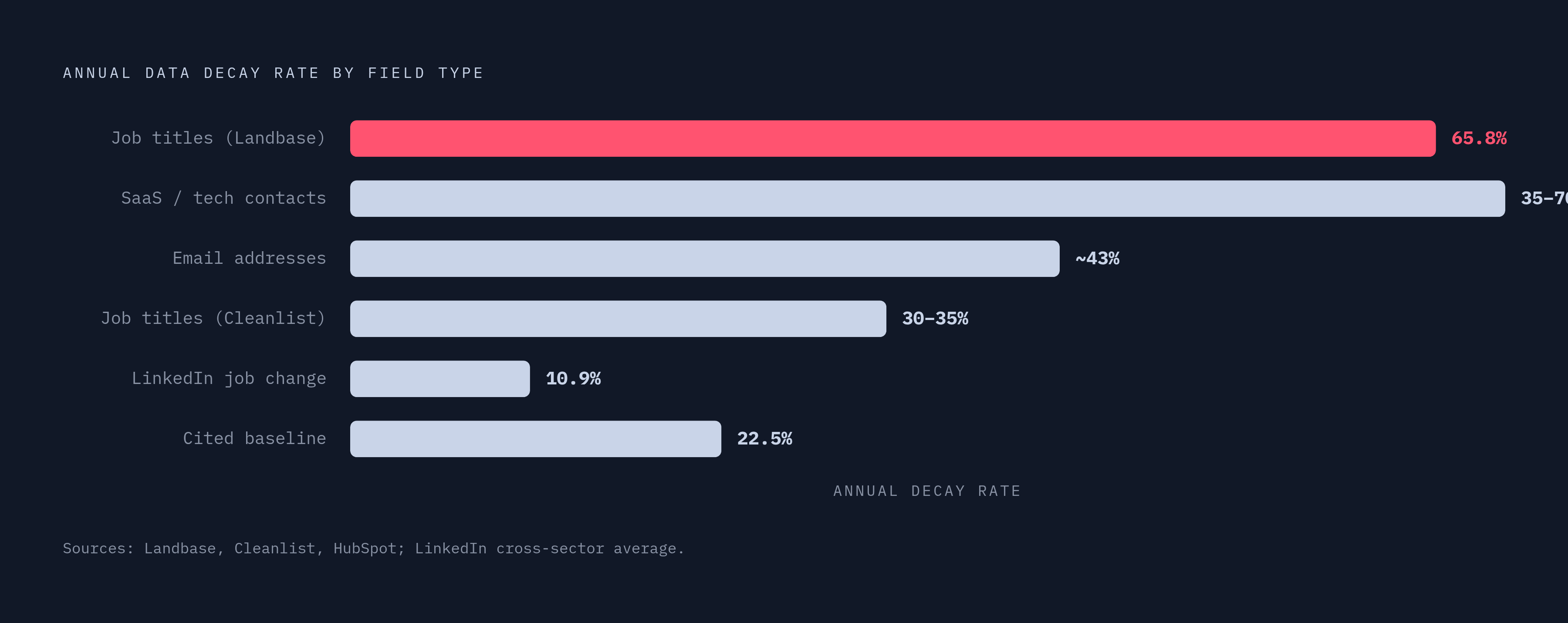
Treating enrichment data as one uniform blob is the planning error that produces most of this. Different fields decay at wildly different speeds, and lumping them together into a single "database" produces a false sense of stability.
Job titles move fastest. Landbase's field-level analysis puts annual title decay at 65.8%, while Cleanlist's separate estimate lands closer to 30-35%, a gap that comes down to methodology rather than disagreement (Landbase measures full multi-field contact decay, Cleanlist isolates title changes alone) cleverly.co cleanlist.ai. Either way, a title captured today has roughly even odds of being wrong within the year. Email addresses decay more slowly but still fast: Landbase clocked the rate at 3.6% a month as of late 2024, and that figure has held as the standard benchmark into 2026, well above the 2.1% baseline for contact data generally HubSpot Database Decay Simulation / MarketingSherpa cleverly.co Cognism.
Company-level data has its own curve. Tech stack data decays on a totally different clock, tied to annual or multi-year vendor contracts, so a tool spotted in a script tag scan last year may have been swapped out quietly with no public announcement anywhere (this framing draws on the general pattern of tech-stack turnover described in the material). Intent data is the most fragile layer of all, valuable mainly when it's paired with an immediate next action rather than stockpiled as a standalone feed.
The job change event is where this gets ugly, because it doesn't hit one field at a time. When someone changes jobs, the work email breaks, the phone extension breaks, and the title breaks, all in the same event. That's three data points invalidated in a single moment, not three separate decay curves ticking along independently.
Then there's a category that no verification tool catches: logical decay. A contact can keep the same email address, pass every automated check a platform runs, and still have moved from VP-level budget authority into a role that no longer matters to the deal. The data is technically accurate and strategically useless, which is a distinction most enrichment tools aren't built to make. Put all of this together and the practical shelf life of enriched data looks a lot shorter than a year. Cleanlist puts enriched data's usable life at roughly 3–4 months before it starts rotting, not a year cleanlist.ai.
The professional mobility engine driving field-level churn
One simple fact about how people work now drives all of this: they don't stay put. Salesmotion puts the average B2B contact's job tenure at about 18 months cleanlist.ai predictleads.com Dun & Bradstreet salesmotion.io amplemarket.com. The person a rep thinks they're reaching out to fresh is usually already partway through their run at that company, not standing at the start of it salesmotion.io.
LinkedIn's own data shows 10.9% of professionals change employer in a given year, but that's a cross-sector blend, and it hides the sectors moving twice as fast Dun & Bradstreet cleanlist.ai. Tech and SaaS run at 15-20% annual turnover Dun & Bradstreet cleanlist.ai LinkedIn. Contact data in those segments ages at roughly double the rate of steadier industries Dun & Bradstreet cleanlist.ai LinkedIn. Job changes account for 15-20% of professionals annually, and on top of that sit acquisitions, closures, office moves, and domain changes, matching Cleanlist's breakdown of decay drivers Dun & Bradstreet cleanlist.ai derrick-app.com. These events don't happen one after another in some tidy sequence. They compound, hitting the same database from multiple directions at once.
Sector and geography together set the real cadence a team needs, and there's no single global number that covers all of it. SaaS and tech can run 35-70%+ annual decay, which makes monthly verification the floor, not a nice-to-have Landbase field-level analysis. Healthcare and financial services are a steadier pace, safe on a quarterly check. Manufacturing and government move slower still, government especially, since public-sector employees tend to stay in role longer than almost anyone else, which makes those databases the most stable and, oddly, also among the hardest to keep current. Every six months tends to be enough for manufacturing. Geography adds another layer on top: Span Global Services has found APAC manufacturing decay running at roughly half the rate of US tech. Knowing decay moves fast isn't the whole story, though. The more useful question is how long a record sits untouched after enrichment before anyone acts on it, and that's where the real damage happens.
The refresh gap: the interval between enrichment and action is where records go wrong
The gap has a name and a number. That's not a small miss.
Run the math on that window. At 2.1% monthly compound decay, a database that is 90% accuracy the day it's enriched has already slipped by the time the next refresh cycle rolls around, because decay doesn't pause while a record waits in queue HubSpot Database Decay Simulation / MarketingSherpa Cognism. It keeps ticking whether or not anyone's watching. This exposes the flaw baked into how most enrichment gets sold in the first place: the "point-in-time" purchase model, where the accuracy figure a vendor quotes describes the moment the data was pulled.
Provider-side lag stacks another problem on top of this. Landbase has pointed out that a provider running a database of 200 million contacts would need roughly 6.34 years of continuous processing to verify every single record at one second per record Dun & Bradstreet landbase.com. No provider actually does that. Instead, most verify a manageable subset and leave the rest sitting there, unvalidated and aging by the day. Database size and database accuracy can end up moving in opposite directions, a fact buyers rarely stop to consider.
Bureau of Labor Statistics data puts median tenure for private sector workers at 3.5 years, which works out to roughly 15-20% of private sector professionals changing roles or employers in any given year, a rate that only climbs faster in quick-moving sectors Dun & Bradstreet cleanlist.ai derrick-app.com.
Put together, the honest version of this story is uncomfortable for anyone planning against the standard 22-30% annual figure: that number is already the conservative case cleanlist.ai unifygtm.com amplemarket.com. The refresh gap means a real share of records are stale before a rep's first outreach touch, not after months of neglect. The rot sets in before anyone even opens the file. The gold standard is a 7-day refresh cycle, but most organizations only re-enrich every 6 weeks, per ConnectSafely (roughly 42 days between refresh cycles on average) connectsafely.ai. Enrichment fires, provider data is already partially stale, the record is in queue for 42 days on average, and the rep finally acts. Instantly's research sets a 90-day refresh cadence as the minimum baseline for CRM hygiene, but decay continues daily between cycles, enough to push bounce rates past the 1% threshold that damages sending domain.
What stale enrichment data costs in measurable terms
The macro number is enormous and, frankly, a little too big to be useful on its own: poor data quality costs U.S. Poor data quality costs U.S. businesses an estimated $3.1 trillion a year, and Gartner's often-cited benchmark puts the loss for individual organizations at $12.9 million to $15 million annually in wasted spend, missed sales opportunities, and operational drag cleanlist.ai derrick-app.com joinsync.substack.com Gartner. That's context, not the argument.
The number that actually lands is smaller and closer to a rep's actual day. ZoomInfo data cited by Salesmotion found reps waste 27.3% of their time, about 546 hours a year, chasing leads built on bad data Salesforce / Landbase. Cleanlist's survey across 47 customers landed on a similar median: 28% of SDR time spent wrangling data instead of selling Dun & Bradstreet. That coincidence points to something real.
Validity's State of CRM Data Management report, based on 602 CRM users, found 37% of organizations had lost revenue directly tied to poor data quality, 76% admitted less than half their CRM data was actually accurate, and the average company was losing around 16 deals a quarter to it Dun & Bradstreet Validity 2025 State of CRM Data Management. Salesforce's own research, cited by Joinsync, found 91% of CRM data is incomplete, stale, or duplicated in some way, which reframes this whole problem as structural rather than an occasional embarrassment. And there's a deliverability angle that makes this worse than a productivity drain: Gmail and Yahoo's 2024 sender requirements turned bounce rate into the de-facto reputation signal for any sending domain, with a 2% ceiling separating inbox delivery from spam folder exile, and stale contact lists blow through that ceiling fast Dun & Bradstreet lessie.ai.
Companies lose roughly 16 deals per quarter to poor CRM data quality Dun & Bradstreet Validity Validity 2025 State of CRM Data Management. Everything else in this section is scaffolding. The 16-deals-per-quarter figure and the 27.3% time figure are the payoff, while the trillion-dollar number is context Validity Salesforce / Landbase ZoomInfo.
How AI deployment raises the stakes for stale enrichment data
AI tools don't fix bad data. They amplify it, at scale, with total confidence. Stale enrichment fed into an AI system doesn't produce a worse output in some obvious, catchable way. It produces an output that looks polished and sounds right and is aimed at a person who left the company four months ago.
Validity's report found 45% of CRM data isn't AI-ready Dun & Bradstreet. A meaningful share of AI SDRs running today are generating outreach off information that's stale, incomplete, or duplicated, and sending it straight to contacts who moved on months earlier Dun & Bradstreet Validity. Gartner's own forecast finds that, through 2026, organizations will abandon 60% of AI projects that aren't backed by AI-ready data Dun & Bradstreet. Salesforce's State of Data and Analytics research backs this up from another angle Salesforce State of Data and Analytics. 84% of data and analytics leaders agree that AI output quality is capped by input quality, 74% of sales teams already running AI now prioritize data hygiene specifically to keep AI performance intact, and 51% of sales leaders using AI say tech silos are slowing or limiting what their AI initiatives can actually do Salesforce State of Data and Analytics. Bain & Company's research points the same direction: most stalled enterprise AI pilots trace back to data readiness problems, not weaknesses in the models themselves Dun & Bradstreet.
Picture an AI SDR running against a Tier 1 contact list that only gets refreshed quarterly. By month nine, a significant share of its outbound is landing on invalid contacts, and that's not a content problem or a sequencing problem. It's a fuel problem. The model is fine. What it's being fed isn't. Teams bolting AI onto outbound without first closing the refresh gap aren't speeding up their pipeline. They're speeding up how fast their decay costs pile up.
How teams should think differently about enrichment cadence given what decay looks like
The fix starts with dropping the idea that enrichment is something that happens once, at intake, and then sits finished. It has to run as a continuous background process, and its pace should track the decay velocity of the specific fields and sectors a team is actually targeting, not some flat annual number pulled from an industry report.
That means different cadences for different segments. SaaS and tech contacts need verification at least monthly, given how fast that segment decays Landbase field-level analysis. Healthcare and financial services can safely sit on a quarterly cycle. Manufacturing and government contacts, moving the slowest of the group, can usually go six months between checks.
Cadence alone doesn't solve gaps in provider coverage, though, and this is where waterfall enrichment earns its place: querying multiple B2B data providers in a set priority order, moving to the next provider only when the current one comes back empty or low-confidence cleanlist.ai predictleads.com Dun & Bradstreet salesmotion.io amplemarket.com. Cleanlist has found that teams switching from a single provider to a waterfall setup see match rate improvements of 20-40%, because no single provider has full coverage across every geography and seniority level Dun & Bradstreet. Real-time verification at the moment of sending closes the last piece of the gap: even with a solid refresh cadence in place, decay keeps running every day between cycles, so checking email validity right when a sequence fires catches whatever went stale in the interval since the last enrichment pass.
Logical decay needs a different kind of answer entirely, since no automated check catches a contact who kept their email but quietly lost budget authority. ICP scoring against firmographic signals, role seniority, department, position within the buying committee, works as a secondary filter here, catching what field-level verification structurally can't.
Teams evaluating enrichment providers should be asking a sharper question than "how accurate is your database." The right question is how accurate a given record is at the exact moment it's being used, since that's the only moment that actually matters to a rep hitting send. Annual decay rates are a fine number to budget against. They're a poor number to operate against. The operational question is always narrower and more specific: how long has it been since this particular record was verified, and how fast does this particular field decay in this particular sector. Industry-specific cadence guidance is grounded in the sector decay data from section three.
Sources
- 7 Reasons Static Data Enrichment Is Dead in 2026 (And What Smart GTM Teams Do Instead)
- B2B Data Decay Rate: How Fast Contact Data Goes Stale
- Data Decay Rate Statistics: 20 Critical Facts Every GTM Leader Should Know in 2026 | Landbase
- B2B Data Enrichment: Tools, AI & Strategy for 2026
- B2B Data Decay Is Costing You Millions: How to Build a Living Data Strategy
- B2B Data Enrichment Stats 2026: Key Facts | Cleanlist
- What Is Data Decay? B2B Data Decay Rates, Tools & How to Fix It
- airscale.io