How an AI Agent Decides Which Account to Work Next
AI agents weigh intent, fit, and urgency to rank accounts more reliably than human instinct alone.
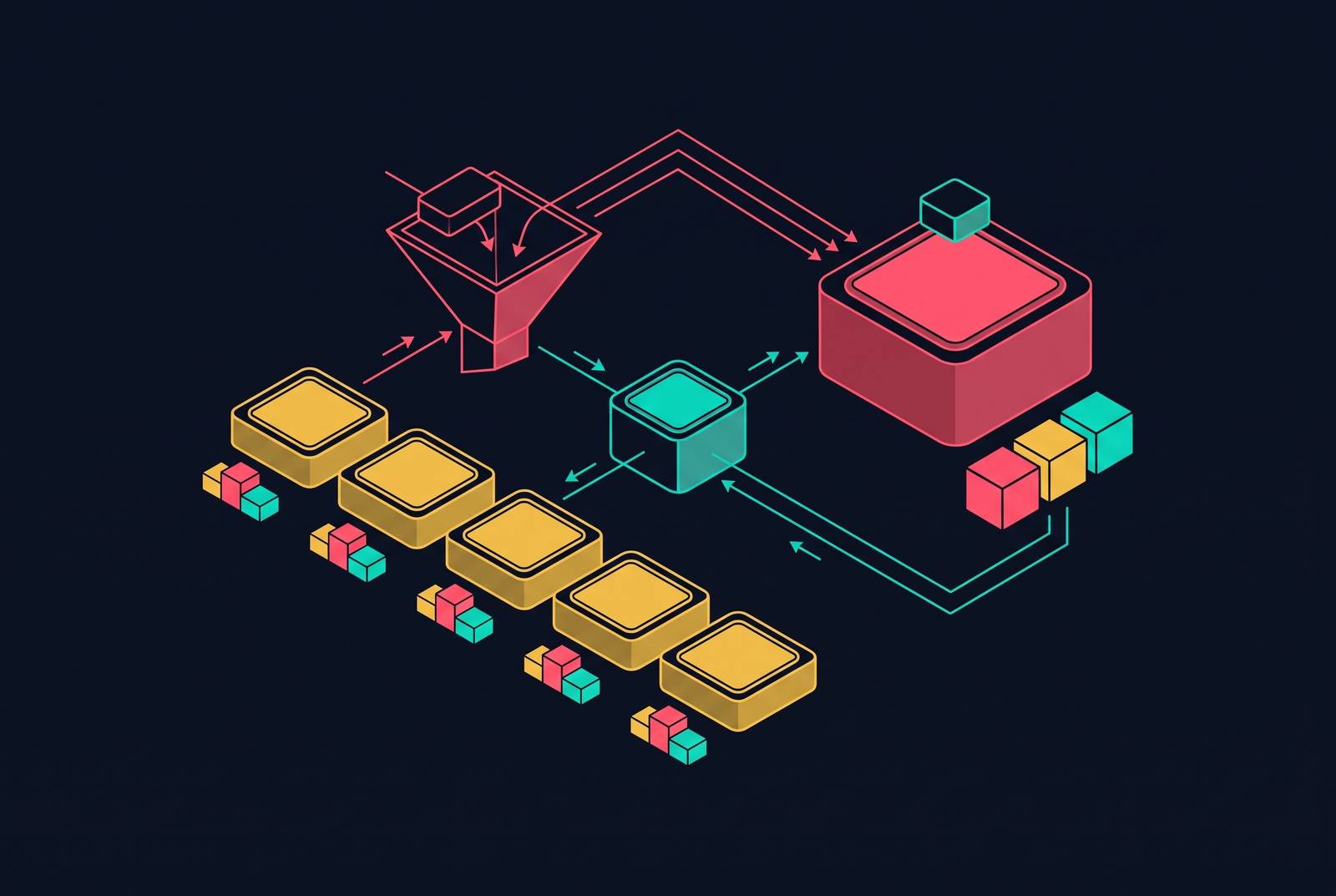
An AI agent deciding which account to work next is weighing a defined set of signals, intent, fit, urgency, and capacity, through a prioritization engine that balances predicted value against the cost of action. Understanding that logic is what lets a sales team trust the output, and more importantly, configure it to match decisions the team would actually stand behind.
Why account prioritization is hard to get right without a structured method
Every rep starts the day the same way: a backlog of accounts, a gut feeling about which ones matter, and no consistent way to defend that ranking to a manager. Another rep ignores the identical pattern because they've learned to distrust email opens. Neither is wrong, exactly, but neither is working from anything sturdier than instinct, and instinct doesn't scale across a twenty-person team, let alone two hundred accounts a week arxiv.org.
The deeper issue is that most of the signal a prioritization decision needs is invisible to a human doing this by hand. Traditional CRM systems capture only about 1% of customer interaction data, according to research from Gartner and Gong gong.io McKinsey. The rest of the signal never even reaches the spreadsheet a rep is ranking from gong.io McKinsey. A manual process can only rank what it can see, and what it can see is a sliver.
This isn't a settled question inside sales organizations, either. HubSpot's 2026 State of Sales Report found that 30% of sales leaders still expect reps to decide which accounts to prioritize without AI assistance, and 29% say reps are left to choose the strategic angle entirely on their own HubSpot 2026 State of Sales Report arxiv.org Gartner. Full autonomous prioritization remains contested territory in most sales orgs, not a problem anyone has fully solved and moved past HubSpot 2026 State of Sales Report arxiv.org Gartner.
The cost of getting the ranking wrong isn't abstract. Time spent working a low-probability account is time a high-intent prospect spends cooling off, and by the time a rep circles back, the window that made the account "hot" may have already closed. Understanding how an AI agent actually structures a prioritization decision is the starting point for trusting its output, and for configuring it well enough that the output is worth trusting.
What an AI agent is doing when it "works" an account
An AI agent, in the strict sense, perceives information, analyzes it, reasons toward a goal, makes a decision, and then performs a task using whatever tools it has access to. That's a meaningfully different animal than traditional automation, which just follows fixed rules someone wrote in advance. The agent runs a loop: observe, understand, reason, act, evaluate, and then the outcome of that action feeds back into the next cycle of prioritization.
Traditional analytics tells a team what already happened. It shows last quarter's close rate, which campaign generated more replies, which rep is behind pace. An AI agent is built to answer a forward-looking question instead, what should happen next, and in some configurations it doesn't stop at the recommendation. It acts on it.
That is the part that matters. The agent isn't only ranking accounts. It's also deciding what to do about the account it just ranked, whether that means an outreach email, a follow-up call, a hold until more signal arrives, or an escalation to a human rep.
Two operating modes matter here, and they differ in specific ways. A reactive agent waits for a trigger, a prompt, a request typed by a person. A proactive agent runs continuously in the background, watching signals arrive in real time and acting without anyone asking it to. Research from Salesmate and zerotoai points to proactive agents as the leading edge of where the field sits in 2026: they don't wait on a human to open a chat window, they listen for webhooks the moment a signal fires and act inside whatever policy gates the team has set arxiv.org. None of this is a black box by design. It's a describable architecture, which makes it something a team can inspect, question, and adjust.
The four signal categories that feed a prioritization decision
Four categories of signal feed into a prioritization decision, and each one plays a distinct role rather than just adding noise to the total.
Firmographic fit, company size, industry, revenue, is slow-moving, but it's foundational: it tells the agent whether an account belongs in the conversation at all against the ideal customer profile. Behavioral and engagement signals sit on top of that: website visits, email opens, content downloads, pricing page views. Frequency and depth affect signal reliability more than raw volume of touches does. Three pricing-page visits inside two days is a far louder signal than five e-book downloads spread across six months, even though the second account technically logged more total touches.
Third-party intent data adds a layer that's invisible to the vendor until it's tracked externally: G2 review-site activity, LinkedIn hiring or event triggers, Crunchbase funding events, BuiltWith technographic data, 10-K filings, and topic surges from providers like Bombora or 6sense. These are signals that a buying window may already be opening before the prospect ever reaches out. Then there's real-time engagement: a proposal that just got opened, a call transcript that mentions budget approval, a pipeline stage that just changed in the CRM gong.io McKinsey. These update the rank immediately, without waiting for a nightly batch job to catch up.
Any prioritization model that runs only on CRM fields is working with a fraction of the available signal, since traditional CRMs capture only 1% of customer interaction data gong.io McKinsey. Garbage signal in produces a ranking that looks confident and reads clean, and is wrong. Better models also incorporate technographic data such as the current tech stack, product usage data for PLG motions, and buying committee signals indicating which individuals inside the account are engaging.
How signals combine into a rank: the scoring engine
The accuracy gap between manual and machine scoring isn't subtle. Companies using AI scoring saw 138% ROI compared to 78% for those that didn't, per that same research, though the payoff is real but depends on model quality warmly.ai.
Most scoring models ask the wrong question, or at least an incomplete one. "Who is most likely to buy" and "where should effort go next" sound similar but produce different rankings, because the second question folds in cost of action alongside probability of conversion.
Treating ICP fit as an additive factor is a common mistake. It means a high-scoring account outside the ideal customer profile can still look attractive on paper when a team is under pressure to hit a number. Treating fit as a multiplier instead collapses any below-ICP account to zero regardless of how loud its other signals are, which enforces the boundary structurally rather than relying on a rep's discipline to catch it manually. Decay matters too: a pricing-page visit from six weeks ago shouldn't carry the same weight as one from yesterday, and models that skip decay-weighting tend to over-rank interest that's already gone cold.
Not every team has the data to run a full predictive model. Training one effectively takes something like 1,000 historical converted leads at minimum involvedigital.com. Below that threshold, a simpler fit-by-intent matrix, crossing fit (high or low) against intent (high or low), delivers most of the same benefit with a fraction of the data requirement. The four resulting cells map to genuinely different correct actions: cold, warm, hot, and the easy-to-miss fourth case of high fit paired with low intent, which calls for nurture and patience rather than a push.
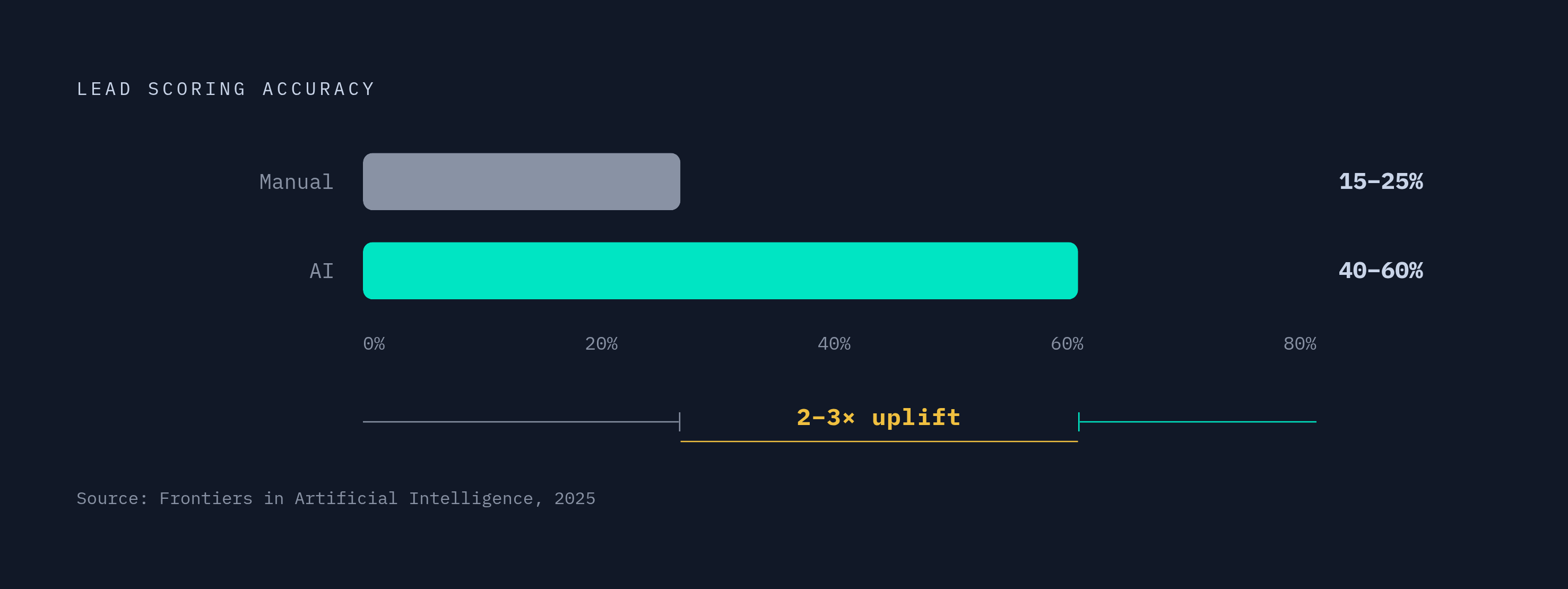
However the score gets calculated, the output a rep actually needs isn't a decimal. Nobody needs to know an account scored 67.3. They need to know whether to call now or nurture later. Practitioners favor tiered bands, A, B, C, D, with routing rules attached directly to each tier. The frontier past that is agent-tuned scoring, where the agent reviews its own win-loss history and adjusts its scoring weights without an engineer opening a config file arxiv.org. As recently as 2025, most teams were still running scheduled cron jobs against hand-tuned weights, so this is a genuinely recent shift, not old news dressed up as a trend arxiv.org. Manual lead scoring achieves 15–25% accuracy while AI lead scoring reaches 40–60% accuracy, a 2–3x improvement, per Warmly.ai research citing a 2025 peer-reviewed Frontiers in Artificial Intelligence study using Gradient Boosting and other models including Random Forest (Gartner, warmly.ai, arxiv.org, Deloitte).
How the agent's queue determines which account it touches first
A ranked list, on its own, isn't a work queue. The agent still needs a separate set of rules governing what gets pulled off that list, when, and in what order, and three scheduling approaches currently coexist, each solving a slightly different problem.
Cron-based scheduling runs on a fixed cadence, nightly, hourly, predictable, but it introduces a lag between when a signal arrives and when the agent notices it. Event-driven scheduling closes that gap: a webhook fires the instant a signal lands, and the agent can act within seconds of the triggering event, which Explorium research names as the recommended architecture heading into 2026 arxiv.org.
The queue's internal structure matters just as much as the scheduling model layered on top of it. A FIFO queue treats every account the same regardless of score. A priority queue lets a high-scoring account jump the line. A deadline-aware queue goes a step further and factors in time sensitivity directly, so a contract renewal expiring inside 48 hours outranks a warm inbound lead even if the inbound lead's composite score is technically higher.
A June 2026 arXiv paper (2606.20058) documents a component called the Task Manager. It maintains a deterministic backlog: task records, status, merged pending events, priority metadata, orchestration state. Crucially, no output from the underlying language model is allowed to mutate that backlog directly until it clears schema validation and configuration checks, which is precisely the mechanism that keeps an autonomous agent from making a runaway decision nobody signed off on. Every incoming event gets evaluated on arrival: create a new task, merge it into an existing one, or discard it. Not every signal that appears in the system earns a slot in the queue.
Preemption works the same careful way. A higher-priority account can interrupt work in progress, but only at defined stoppage points, never mid-action, and the interrupted task's state gets saved so it can resume cleanly once the more urgent work clears. That single detail is what separates a well-governed agent from one that just drops work silently and hopes nobody notices.
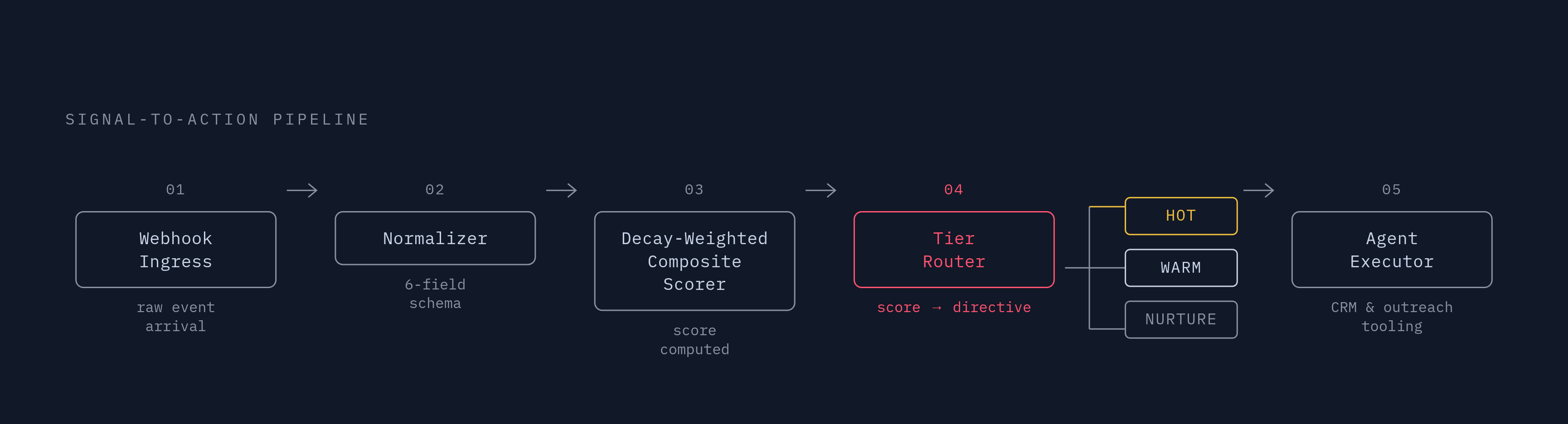
Explorium's recommended pipeline lays this out end to end: a webhook ingress, a normalizer that maps everything into a canonical six-field schema, a decay-weighted composite scorer, a tier router that sorts into Hot, Warm, or Nurture, and finally an agent executor that acts on the Hot tier through CRM or outreach tooling. Capacity constrains all of it. Configurable concurrency limits keep an agent from trying to work more accounts at once than it can actually handle well, and token spend and API costs are real operating expenses that have to be weighed against priority and expected return, a point raised on CXOTalk episode 916.
What happens to prioritization logic when the number of accounts scales up
Scale changes the math in ways that catch teams off guard. The same June 2026 arXiv paper (2606.20058) evaluated 208 production-derived enterprise scenarios across three scales: Persona (fewer than 10 agents), Department (20–80 agents), and Enterprise (200 agents) arxiv.org. The headline finding is that scale, not task complexity, is what dominates orchestration performance. Both major architectures tested held up fine at small scale and degraded once they hit enterprise scale, with agent discovery noise emerging as the real bottleneck rather than the difficulty of the underlying task Gartner arxiv.org.
The counterintuitive part is that simple tasks degrade faster than complex ones once scale climbs. At enterprise scale, the overhead of just locating the right agent to hand a task to ends up swamping the actual work the task required.
The Task Manager component held up meaningfully better under that pressure, cutting high-priority queue latency by 14% to 75% and improving related-event correctness by more than 20 percentage points at enterprise scale Gartner arxiv.org. A prioritization setup that performs well in a 50-account pilot can produce noticeably different results at 5,000 accounts, and not because the scoring logic itself changed, which is the blunt practical takeaway for anyone planning a rollout. The orchestration layer can't keep pace, which is what produces the diverging results at scale.
Memory adds another wrinkle. An agent without persistent memory re-scores accounts from scratch every session. It can quietly reverse a decision it made a day earlier with no record of why. Symphony Solutions' 2026 research found memory architectures alone improved accuracy by roughly 26% while also cutting latency and token cost arxiv.org houseblend.io. Any team planning to scale past a pilot should pressure-test the queue architecture at the volume they're actually targeting before locking in a scoring model. More often than not, the bottleneck is delivery.
The governance layer: what controls how much the agent can decide on its own
Reactive mode waits for a trigger or prompt, while proactive mode runs continuously, monitors signals, and acts without being asked. Configurable concurrency limits prevent an agent from attempting to work more accounts simultaneously than it can handle well, since token spend and API costs are real operational costs that must be managed against priority and ROI, per CXOTalk episode 916. Bounded workflows with clear inputs and measurable outputs can run on their own, while ambiguous or regulated decisions need a human approval gate before anything moves.
Gartner predicts that more than 40% of agentic AI projects will be canceled by 2027, with unclear ROI paired with weak governance cited most often as the reason warmly.ai arxiv.org Deloitte. The failure mode is deploying an agent without ever defining, in writing, what it's actually allowed to decide on its own Gartner warmly.ai arxiv.org Deloitte.
Governance over a prioritization agent breaks down into a few concrete pieces. Data access covers which signal sources the agent can read, and just as important, which ones it's blocked from touching for privacy or compliance reasons. Action rights separate what the agent can do without asking, sending an email, updating a CRM field, from what needs a human sign-off first, reassigning an account or triggering a contract workflow. Audit trails matter enormously here too: every prioritization decision should log the signals and weights that produced it, since that log is the only thing that makes human review possible and the only way anyone catches model drift before it compounds. Escalation paths round it out. What happens when the agent hits an account it genuinely can't classify with confidence affects whether errors get caught, because a silent default is worse than a flagged uncertainty.
The Task Manager's policy gates enforce this at the architecture level rather than leaving it to convention: configuration constraints get validated before any event is allowed to touch the backlog, and if validation fails, the system retries with error feedback or falls back to a safe default. Events are never just dropped silently.
Gartner's broader forecast bears directly on the point here too. Enterprise applications are expected to reach 40% embedded-agent penetration by the end of 2026, up from under 5% in 2025 Gartner warmly.ai arxiv.org Deloitte. Governance retrofitted after deployment at that scale is a far harder problem than governance designed into the architecture from day one Gartner warmly.ai arxiv.org Deloitte. And HubSpot's finding, that 30% of sales leaders still expect reps to own prioritization without any AI involvement, is a signal that governance here is as much a change-management question as a technical one, about exactly where the line between human judgment and agent judgment gets drawn HubSpot 2026 State of Sales Report arxiv.org Gartner.
How to configure a prioritization agent to make decisions your team would endorse
The arXiv paper's configurability principle is the right place to start: the priority formula is meant to be adjustable, weights, thresholds, priority mapping, tuned to match how responsive a workload needs to be, what counts as fair distribution, and how costly context-switching actually is for the team running it arxiv.org. Once those parameters are set, the backlog ordering becomes deterministic: the same inputs produce the same output every time, which is the property that makes an agent's decisions auditable rather than mysterious arxiv.org.
Before any tooling gets touched, the four inputs need to be defined explicitly, not assumed. Which intent signals does the team actually trust, based on what's historically closed? What does the ICP multiplier include, and just as important, what does it structurally exclude, not by convention but by rule? Which events, a renewal date, a form fill, a competitor mention, should be allowed to preempt the standing queue? And realistically, how many accounts can the agent and the humans working alongside it actually act on in a day without quality dropping?
Format the output for action, not for precision theater. Tiered bands with routing logic attached tell a rep, or a downstream agent, what to actually do next, not just where an account sits on a scale nobody has time to interpret. And validate against real outcomes as they come in: teams without roughly 1,000 historical converted leads on hand should lean on the fit-by-intent matrix rather than force a predictive model that doesn't have enough data to train on yet involvedigital.com.
Treat the first deployment as something to watch closely, not something to set and walk away from. Agent observability, logging every decision, tracking which signal drove which action, reviewing outcomes on a cadence, is becoming close to mandatory as teams hand agents more autonomy, according to Salesmate's September 2026 analysis arxiv.org. Platforms that support configurable prioritization with CRM-native integration, persistent memory, and audit trails a person can actually open and read are the ones to evaluate. The architecture should be something a team can inspect, not a vendor's black box sitting between the rep and the decision.
An AI agent deciding which account to work next runs a defined logic against a defined set of signals, inside whatever policy gates a team has chosen to set, and the teams that take the time to understand that logic are the only ones actually positioned to improve it.
Sources
- AI Agents in Finance 2026: A CFO Guide to Reality vs Hype | Houseblend
- The 2026 AI Agent Transition | Compoze Labs
- AI Agent Strategy | 2026 Guide | The JADA Squad
- Autonomous Event-Driven Multi-Agent Orchestration for Enterprise AI at Scale
- How to Use Buying Signals and Event Triggers to Time AI Agent Outreach
- AI Sales Task Prioritization 2025: Boost Rep Productivity - Gong