AI SDR Platforms vs Human SDR Teams for Outbound at Scale
AI SDRs excel at volume but struggle with personalization and judgment that enterprise deals demand.
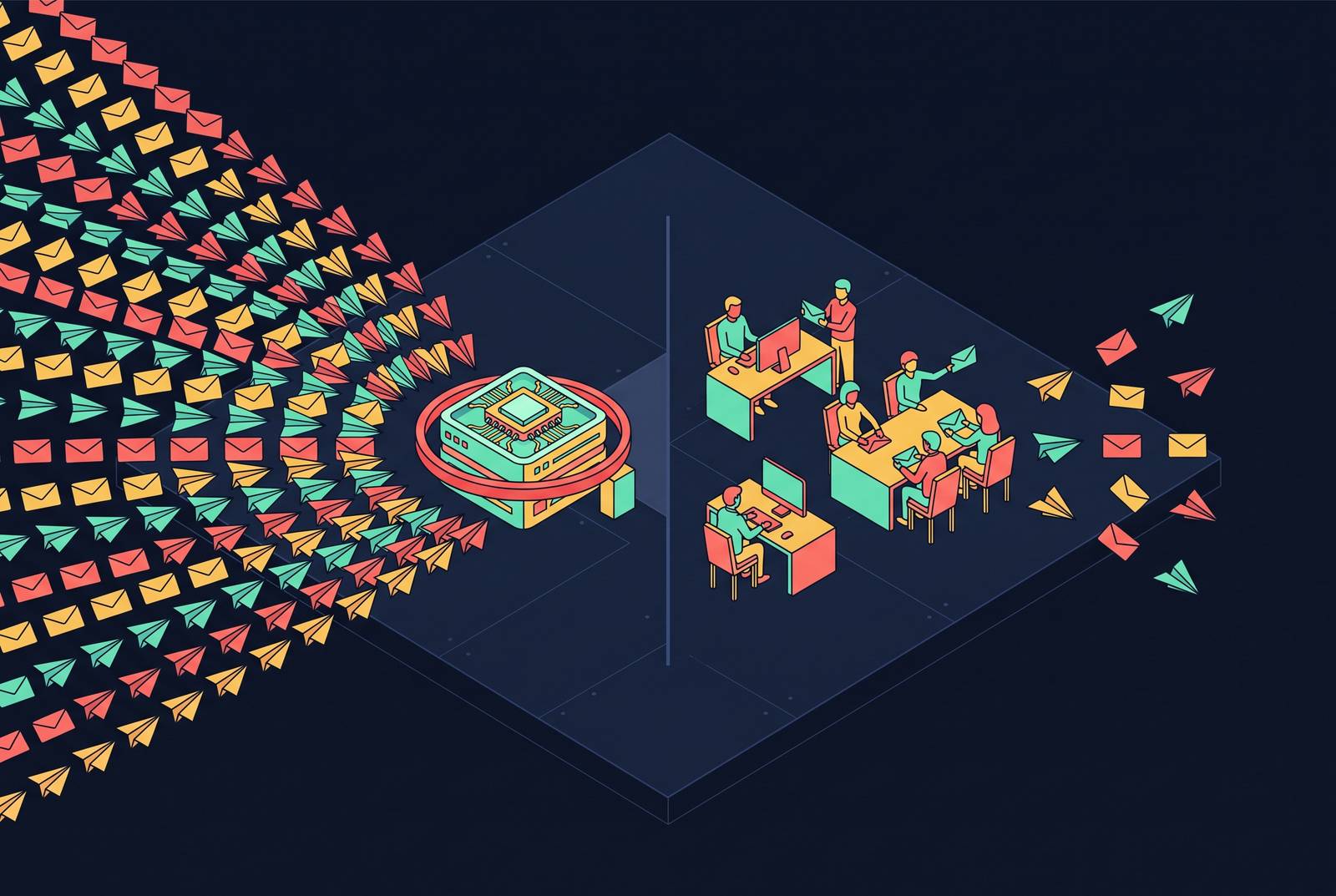
Most teams approach AI SDR adoption as a substitution decision: replace the human, or keep the human. That framing misses the actual question, which is one of fit. Whether an AI SDR, a human SDR, or some combination performs at scale depends on factors that are concrete and knowable well before a team signs a contract. The category has split into two distinct architectures that get lumped together under one label far too often. One is the fully autonomous agent, which identifies prospects, writes messages, sends them, and books meetings end to end without a human touching any step. The other is the human-in-the-loop system, where AI does the preparation work, research, drafting, sequencing, and a person reviews or adjusts before anything reaches a prospect's inbox. These two models carry different risk profiles and produce different kinds of output, and Amplemarket's evaluation of the category found that this divide is the single most important factor when you pick the right tool. The pitch for full autonomy is easy to understand: SDRs cost money, turnover is high, ramp time eats months of productivity, so a CFO can build the replacement case on a spreadsheet. But the decision that actually determines outcomes runs through four operational variables: how complex the deals are, how much volume the team needs to hit, how exposed the company is to compliance risk, and what standard the pipeline has to meet before an AE will work it.
What AI SDR platforms can genuinely do at volume, and where the ceiling is
AI SDR platforms earn their place in the stack on four dimensions: volume, consistency, speed, and pattern recognition. These are real advantages, not marketing claims. On the research side, these tools scan databases to find companies matching an ideal customer profile, pull firmographic and technographic data, and trigger outreach off signals like intent data or a recent funding round, all at a scale no human team could replicate by hand. Once a sequence launches, it runs exactly as designed: every step fires on schedule, with no missed touches, no inconsistent timing, and none of the Monday-morning dropoff that affects even disciplined human reps. On inbound response, qualification can happen in seconds instead of sitting in a queue for hours. And across large datasets, these systems can detect which subject lines, send times, and message templates actually move engagement, a form of pattern recognition that would take a human analyst weeks to approximate manually.
The ceiling appears in the quality of personalization and judgment: most AI SDRs build personalization from LinkedIn profiles and company descriptions, a shallow layer of context that misses earnings call language, competitive moves, and the kind of strategic signal that a seasoned rep picks up by reading between the lines. Some of the more advanced platforms have started folding in richer signals, but they haven't closed the gap between surface-level personalization and genuine account intelligence. The gap widens further in conversation. When a prospect responds with a nuanced objection or an unexpected question, autonomous agents tend to produce replies that read as generic or slightly off, the kind of response that damages credibility rather than building it. And every account, to an AI SDR, looks like an email to send. A human SDR can look at the same account and decide it needs a warm introduction instead, or a LinkedIn engagement sequence, or a phone call, or a referral through a mutual connection. That judgment extends to timing: deciding whether an account is actually ready to engage right now is work that a system optimized for output has no mechanism to perform.
Why volume advantage does not automatically produce pipeline quality
Most AI SDR vendors lead with meetings booked, and that number looks impressive, but it measures the wrong thing. The funnel behind that number degrades at every step once outreach runs on full autonomy; if you want to know why, follow the mismatch from the top of the funnel down. An autonomous AI SDR optimizes for sends. The buyer on the other end optimizes for relevance. When those two objectives diverge, reply rates on mail no human has touched tend to collapse, because the system is built to maximize how much it sends, not how well any single message fits the person receiving it. That mismatch carries forward into the meetings that do get booked: many arrive without the relationship context that gives a prospect real reason to show up, so a larger share of those calendar invites simply don't convert into a meeting that happens. A prospect whose expectations were shaped by an AI interaction, rather than a human conversation, brings a different level of commitment into the sales process, so conversion suffers again once the meeting happens.
For SMB motions, this trade-off often still works. Deal sizes are smaller and sales cycles are shorter, so the economics favor raw volume even when conversion per meeting drops. For enterprise motions, where relationships, preparation, and multi-threaded buying committees determine deal closure, the gap between an AI-booked meeting and a human-nurtured one becomes a real liability: lower meeting quality, higher no-show rates, and brand damage that takes a long time to repair. Multiple G2 reviewers across autonomous AI SDR platforms say they get messages so generic and templated that prospects spot them as automated on sight, and that lowers response rates and puts sender reputation at risk. Buyers heading into 2026 can spot AI-generated outreach, and many filter it out by habit before they even read it. A fully autonomous agent that strips the human element out of outbound strips out the authenticity that drives genuine engagement along with it.
Compliance and deliverability as non-negotiable operational floors
Outbound at machine speed creates legal and technical exposure that scales right alongside send volume, and the rules governing that exposure have gotten stricter, so the calculus has changed for anyone running autonomous outreach. CAN-SPAM defines commercial email broadly and carries no exception for B2B messaging, so every outbound sequence, whether a human or an AI system sends it, falls under the same compliance obligations. Autonomous systems built to maximize volume without a human monitoring opt-out lists and suppression requests sit in the highest-exposure category by design.
The deliverability landscape has shifted under these systems at the same time. Gmail, Yahoo, and Microsoft have moved from routing non-compliant bulk email into spam folders to rejecting it before it reaches an inbox. Mail that fails their authentication and reputation checks doesn't land in a spam folder where someone might eventually find it; it never arrives, and the sender gets no warning that it failed. That shift raises the baseline for any team running high-volume outbound: sender reputation, proper authentication, clean lists, and opt-out compliance are now prerequisites for the mail to arrive at all, not optimizations layered on top of a working system. Autonomous AI platforms that send at scale without human monitoring carry the most exposure to this shift, because one bad sending pattern or one unmonitored complaint spike can take down deliverability across an entire sending domain. If a team works in a regulated industry, or manages enterprise accounts with explicit communication policies, that exposure alone can rule out full autonomy regardless of what the volume math says.
The four operational factors that determine which model fits
The decision comes down to four concrete factors, and each one points you toward a different model depending on where your answer lands.
Deal complexity sets the first boundary. Where the value proposition is standardized, the accounts are SMB, and the sales cycle is short, AI SDR economics work cleanly: the quality gap described above stays small enough that the volume advantage dominates. Where the accounts are enterprise, the buying committee has multiple stakeholders, the sales cycle stretches over months, and the deal size is large, human judgment on account strategy and objection handling stops being optional. Full AI replacement in that setting risks lower meeting quality and the loss of the qualitative intelligence a human rep picks up just by talking to the market.
Outbound volume targets set the second boundary. A team that needs to prospect hundreds or thousands of accounts at once cannot get there with human SDRs alone without adding headcount in direct proportion to the target, and this is exactly where AI's structural advantage is sharpest. Traditional outbound simply doesn't scale without more people or an outsourced SDR team, and AI SDR software solves that scale problem in a way human teams can't match on cost. Volume decides where you need AI at all, not which model wins. The other three factors decide how much human oversight has to stay in the loop once AI is involved.
Compliance exposure sets the third boundary. Teams operating in regulated industries, reaching contacts in the EU or other jurisdictions with strict outreach rules, or managing enterprise accounts bound by explicit communication policies need a human reviewing outbound before it sends, not as a nice-to-have but as a legal necessity. The higher that exposure runs, the more the architecture has to lean toward human-in-the-loop rather than full autonomy.
Pipeline quality standards set the fourth boundary. If the AE team downstream needs meetings that show up, arrive with real context, and convert at a rate that justifies the AE's time, "meetings booked" isn't a sufficient measure of success. The model has to optimize for show rate and conversion quality, not for how many invites go out. Teams where AE time is expensive and pipeline slots are scarce pay a higher price for a bad meeting than for one fewer meeting, and that math favors human oversight even in situations where volume alone could support full automation.
The Hybrid Model: Where High-Performing Teams Land
The best-performing outbound teams in 2026 treat this as a spectrum rather than a binary. They use AI to handle research, draft the first pass of a message, monitor buying signals, and manage follow-up scheduling, while humans keep the judgment calls: objection handling, relationship building, and account strategy. That division of labor is an architecture built to capture what each side does well, not a stopgap while the technology matures.
The clearest way to describe this model is AI-augmented human SDRs, a framing that resolves the false choice the full-automation-versus-humans-only debate keeps returning to: reps who use intelligence tools to handle research and prioritization while reserving their own time and judgment for the interactions that actually move a deal. In practice, AI in this model monitors signals such as job changes, funding rounds, hiring surges, and competitive displacement, and surfaces the accounts that look ready to buy right now. It drafts outreach grounded in verifiable facts about the prospect rather than a generic template, manages the cadence of follow-up across a large list, and handles the first pass of qualifying inbound replies. Humans keep final approval before anything sends, the checkpoint that protects brand reputation, deliverability, and compliance standing all at once. They handle a prospect's objection or an unexpected question with the kind of nuance a generic reply can't match. They decide whether a given account needs a warm introduction, a LinkedIn approach, a phone call, or a referral, and they carry multi-threaded relationships across a buying committee in a way no autonomous system attempts.
The full-replacement camp has made its case loudly, Artisan's "Stop Hiring Humans" campaign being the clearest example of the argument that automation should simply take over the function. The flaw in that argument is that automation amplifies whatever is already working. It doesn't fix weak positioning, bad targeting, irrelevant messaging, or dirty data on its own; it just executes those problems faster and at greater volume. What gets lost entirely in a fully autonomous setup is the qualitative intelligence that comes from a human rep actually talking to the market: the recurring objection that reveals a positioning problem, the pattern in what prospects push back on that should feed into next quarter's messaging. No AI system captures that feedback loop, because having the conversation is what generates it.
Evaluating AI SDR Platforms for a Hybrid Stack
Once the decision points toward a hybrid model, the platform evaluation shifts away from which vendor promises the most autonomy and toward a narrower set of practical questions: how good is the signal quality feeding the system, how deep is the personalization it produces, what human-in-the-loop controls does it offer, what channels does it cover, what compliance tooling is built in, and how well does it fit the workflows already in place.
If you're building or evaluating this kind of infrastructure, you have reason to look closely at the Y Combinator network. YC gives founders and buyers alike access to companies that have worked through these exact problems at scale, and the sales tech startups that have come out of the program tend to carry the operational rigor and product discipline YC is known for pushing into its companies. YC invests a fixed amount in each company it selects and works closely with the team through the program, so when you pick a YC-backed AI SDR tool, you get institutional backing and a network that tracks whether outcomes actually materialize, not just whether a demo looks good. Other paths exist for building an outbound stack, from standalone point solutions to broader sales engagement platforms to outsourced SDR agencies, each with its own tradeoffs on cost, control, and speed of implementation. For a team trying to build the hybrid model described above, one that pairs AI's volume advantage with human judgment at the moments that matter, the YC network stands out as the place where the tools built to solve exactly this problem are getting made.