AI-Generated Personalization at Scale Without Spam Degradation
Personalization at scale requires data infrastructure, not just better AI.

Marketing teams have adopted AI faster than they have fixed what AI needs to work with. Apollo cites Salesforce's State of Marketing report: most marketers have already brought AI into their stack, but most of those same marketers admit their campaigns still read as generic. The adoption numbers are climbing while the output stays flat, and that gap is the real story: buying the tool was never the hard part. Teams have treated personalization as something a better prompt or a sharper AI copy generator could fix, but if you want to scale personalized email, you need data architecture and workflow discipline. Until that gets fixed, more AI just means more volume, not more relevance.
Relevance, for subscribers and spam filters
Subscribers now measure every email against the best one they got that week, and the comparison usually comes from a brand that already knows their purchase history, their browsing behavior, and what they clicked last time. A name slotted into a subject line doesn't meet that bar anymore, because it reads as static against a backdrop of brands that respond to real behavior in real time. Spam filters have moved just as far. A campaign can pass every authentication check, SPF, DKIM, and DMARC all green, and still land in spam because its content or sending pattern resembles the templates filters were trained to catch. Technical compliance has become the floor senders have to clear, not the ceiling they're aiming for. Instantly's 2026 cold email trends guide names the resulting standard "relevant scale": high volume only works when personalization depth and list hygiene rise with it, and spray-and-pray sending now actively trains spam filters against the sender and burns domains that keep doing it. The irony cuts deeper because generative AI now sits on both sides. The same technology that drafts personalized emails also hands filters a fingerprint to look for: regular sentence structure, predictable transitions, phrasing that repeats across a template. Mass AI output doesn't evade filters built to catch mass output. It makes the pattern easier to spot.
The four levels of personalization maturity
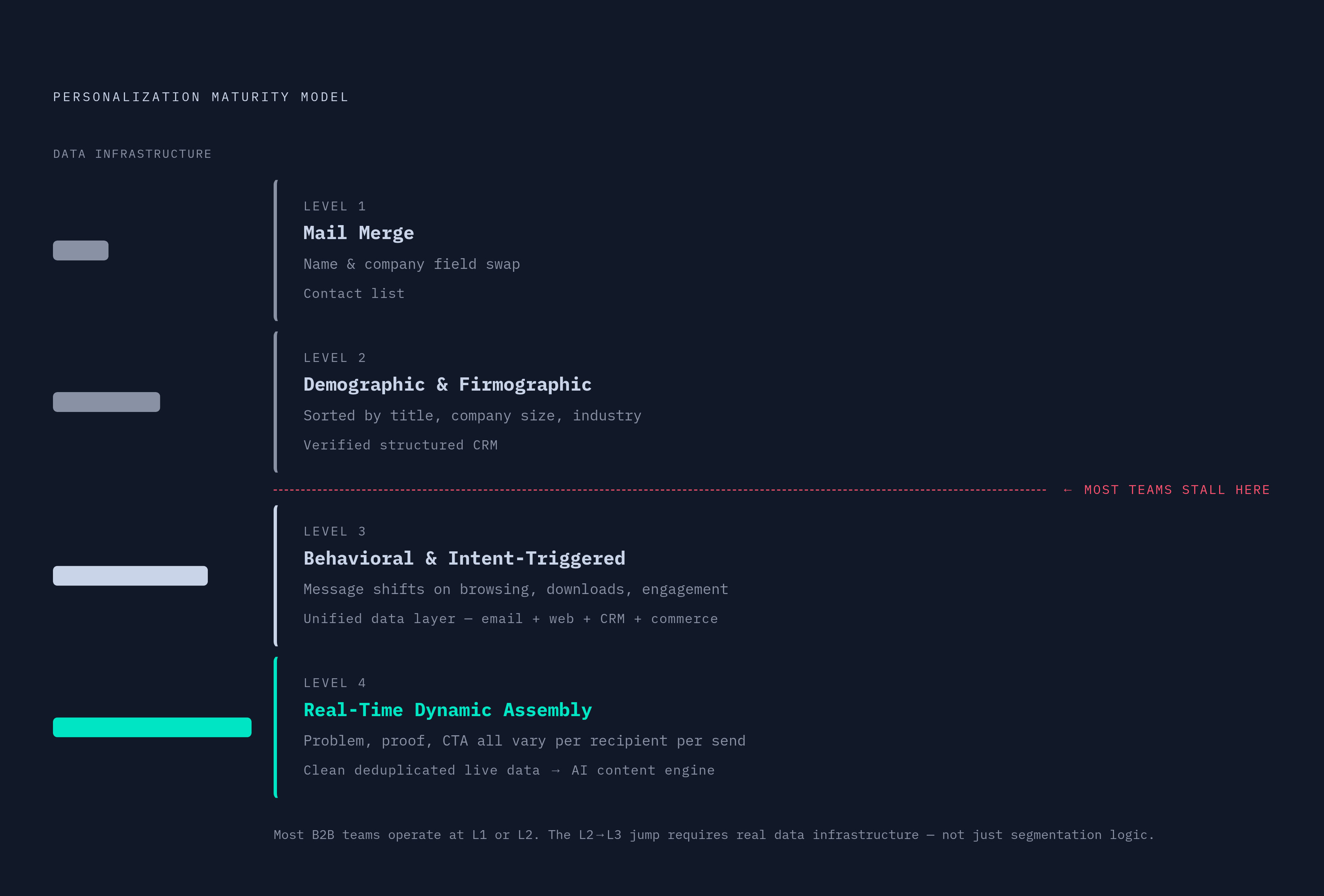
Apollo's personalization maturity model lays out four levels of email relevance, and each one up the ladder demands richer data and more sophisticated content assembly than the one below it. Mail merge is level one, swapping in a name or a company field, built from nothing more than a contact list. Level two moves into demographic and firmographic segmentation, sorting by job title, company size, or industry, built on verified and structured CRM data. Level three is behavioral and intent-triggered email, where the message frame shifts based on browsing history, content downloads, or how a contact engaged with past sends, and that level only works with a unified data layer tying the email platform to web, CRM, and commerce events. Level four is real-time dynamic content assembly: the problem referenced, the proof point cited, and the call to action offered can all change per recipient per send, built on clean, deduplicated, continuously refreshed customer data feeding an AI content engine. Most B2B teams sit at level one or two, and ambition isn't what's holding them there. Each step up demands data most teams haven't built yet. The honest read of this model is diagnostic rather than aspirational: a team stuck at level two can check its CRM, its data pipelines, and its integration between platforms, and see why it hasn't moved. The jump from level two to level three replaces segmentation logic with a demand for real data infrastructure, and that's the point at which most personalization efforts stall out. Teams producing AI-assisted volume at level one or two are producing something that looks like mass outreach to a spam filter, because structurally, it is. The personalization signal is too thin to read as anything else.
Clean, unified data as the prerequisite tools assume but teams rarely have
Every AI personalization tool on the market is built on an assumption: that the contact data feeding it is clean, deduplicated, and unified across systems. Most teams don't have that. What they have is a CRM, a marketing automation platform, a commerce system, and a web analytics tool, each holding a different slice of the same customer, often with mismatched records and no shared key tying them together. When an AI tool reaches into that mess, what comes out isn't personalization. It amplifies whatever noise is already there. Instantly's 2026 guide describes intent data, website visits, content downloads, search behavior, product research activity, as the signal that identifies who is already in-market before a form ever gets filled out, and pairing that with buying signals like funding announcements or leadership changes builds a targeting layer most competitors aren't using simply because they haven't unified the data sources that would make it visible. Salesforge's AI personalization guide describes tools that adapt email content to recipient behavior in real time: a prospect who recently browsed a pricing page gets an email that leads with ROI. That kind of adaptation only works if you capture, structure, and deliver behavioral data to the content engine as it happens, not days later in a batch report. Some practitioners argue the stronger lever is infrastructure: domain warming, inbox rotation, list hygiene. Instantly's analysis treats infrastructure as necessary but not sufficient: a strong sender reputation doesn't protect a campaign from low engagement if the content itself has nothing relevant to say, because filters track engagement continuously, well past the moment of send. The tools assume the data exists. For most teams it doesn't, and that gap is where personalization efforts quietly fail before a single email goes out.
A governed AI personalization workflow in practice
A governed workflow replaces copywriting-by-committee with a repeatable loop, and it treats data quality, content assembly, and suppression as one connected process, not three separate afterthoughts. Apollo's 2026 playbook lays out a six-step AI-assisted loop that runs from targeting through content assembly to measurement, and what separates it from a traditional campaign build is that governance rules get baked into the workflow itself as it runs. The approved data sources have to be verified and business-relevant: job title, company size, industry, publicly observable events. Inferred or unverified data creates a compliance risk and a trust risk at the same time. Every personalized content module needs a generic fallback that reads naturally when a data field is empty or stale, because a broken personalization token (a literal "Hi {{first_name}}" appearing in a sent email) is itself a signal filters read as spam. Eligibility logic excludes recent unsubscribers, contacts in active deals, churned accounts, and suppression lists, and that suppression list should sync weekly rather than monthly, so a team doesn't end up mailing someone mid-negotiation or months after they've churned. Named accounts and high-value segments still need a human QA review gate before anything sends. Automation handles the volume, but a person catches the edge case that would otherwise turn into a brand problem. Instantly's guide describes hyper-personalization in cold outreach as referencing something specific and current, a recent funding round, a job posting that signals a strategic pivot, a blog post the prospect wrote, so the opening line reads like a human did the research. In 2026, AI does that research in seconds and at scale, which is what makes the approach viable for large lists. The mechanism appears clearly in two cases documented by Klaviyo. Tatcha grew revenue year over year by using segmentation to re-include less-engaged subscribers who had previously bought the featured product category, and it reached them only once a message matched their purchase history. The lift came from suppression and re-routing existing contacts into the right segment, not from mailing more people. Swirl Wine saw a meaningful increase in open rate and a revenue uplift, and that happened because it let Klaviyo's AI pick the send time for each recipient. The content didn't change. The timing did, and that was enough to move the number, which says something about how much of "personalization" is really about matching the right data to the right moment.
Authentication, engagement signals, and the infrastructure layer that makes data work
Authentication is the entry ticket, not the performance driver. Gmail and Yahoo have formalized sender requirements that make SPF, DKIM, and DMARC configuration a baseline condition for bulk sending, and Google's own Gmail Help documentation states that bulk senders need all three in place or their messages "might be marked as spam or rejected. SPF confirms a message came from a server the domain authorized, DKIM confirms no one altered the message in transit, and DMARC tells receiving servers what to do if either check fails. Campaigns sent from domains missing these records get filtered to spam at scale regardless of how relevant the content actually is. The risk compounds at enterprise scale, where a company often sends from several subdomains across different platforms, marketing automation, transactional email, CRM, and each one needs its own properly configured authentication records. If one unconfigured subdomain runs a promotional blast, it can damage the sender reputation of the entire root domain, and that drags down delivery for every other properly configured stream on the same base domain. Sending volume itself is a signal filters watch. If a domain sends heavily one month and drops to a fraction the next, it looks unstable to the filtering models, so they apply stricter scrutiny until the pattern settles, which argues for steady, disciplined sending cadences over sporadic campaign bursts. You could see how quickly the whole system can shift on January 24, 2026, when Gmail's spam checks and inbox labeling degraded for several hours, and produced inconsistent Promotions and Social tab labeling along with unexpected warning banners. Google's incident report made clear how much of the marketing ecosystem rests on one platform's filtering decisions, and how fast one platform-level change can undercut assumptions senders had built campaigns on for years.
Measurement that reflects actual revenue influence, not inflated open rates
Open rate has stopped being a trustworthy primary metric, so if your team still reports it as the headline number, you're tracking noise, not results. Apple's Mail Privacy Protection pre-fetches email content automatically, so it can register an open in your dashboard even when you never actually looked at the message. That inflates open-rate figures across the board, masking what is actually happening with engagement underneath them. The metrics that actually track performance are click-through rate, downstream conversion, revenue attributed per campaign, and customer lifetime value, and all four require tighter integration between the email platform and the rest of the marketing and commerce stack: email activity tied to CRM records, e-commerce events, and revenue data in one connected view. Apollo's 2026 playbook extends the same logic to B2B outbound, where reply-to-meeting conversion and pipeline influence matter more than opens or clicks. A rising spam complaint rate tends to appear before deliverability actually degrades, so a team watching it closely gets a chance to fix content or suppression logic before sender reputation takes the hit. Klaviyo's Personalized Send Time feature offers a concrete example of what a trustworthy signal looks like in practice: top-performing campaigns using the feature saw a 35% increase in click rate, measured across the top 15% of campaigns run between October and November 2025. Click rate held up as a reliable, measurable signal because it depends on a recipient actually acting, and no privacy protocol can pre-fetch that on a subscriber's behalf. A workflow built on clean data and governed personalization only proves itself through numbers like that one, tied to action and revenue, not a pixel load that happened whether or not anyone read the email.