Agentic ICP Discovery Tools for Early-Stage B2B Founders
Signal-based tools solve both the who and where problems that static databases leave unsolved.
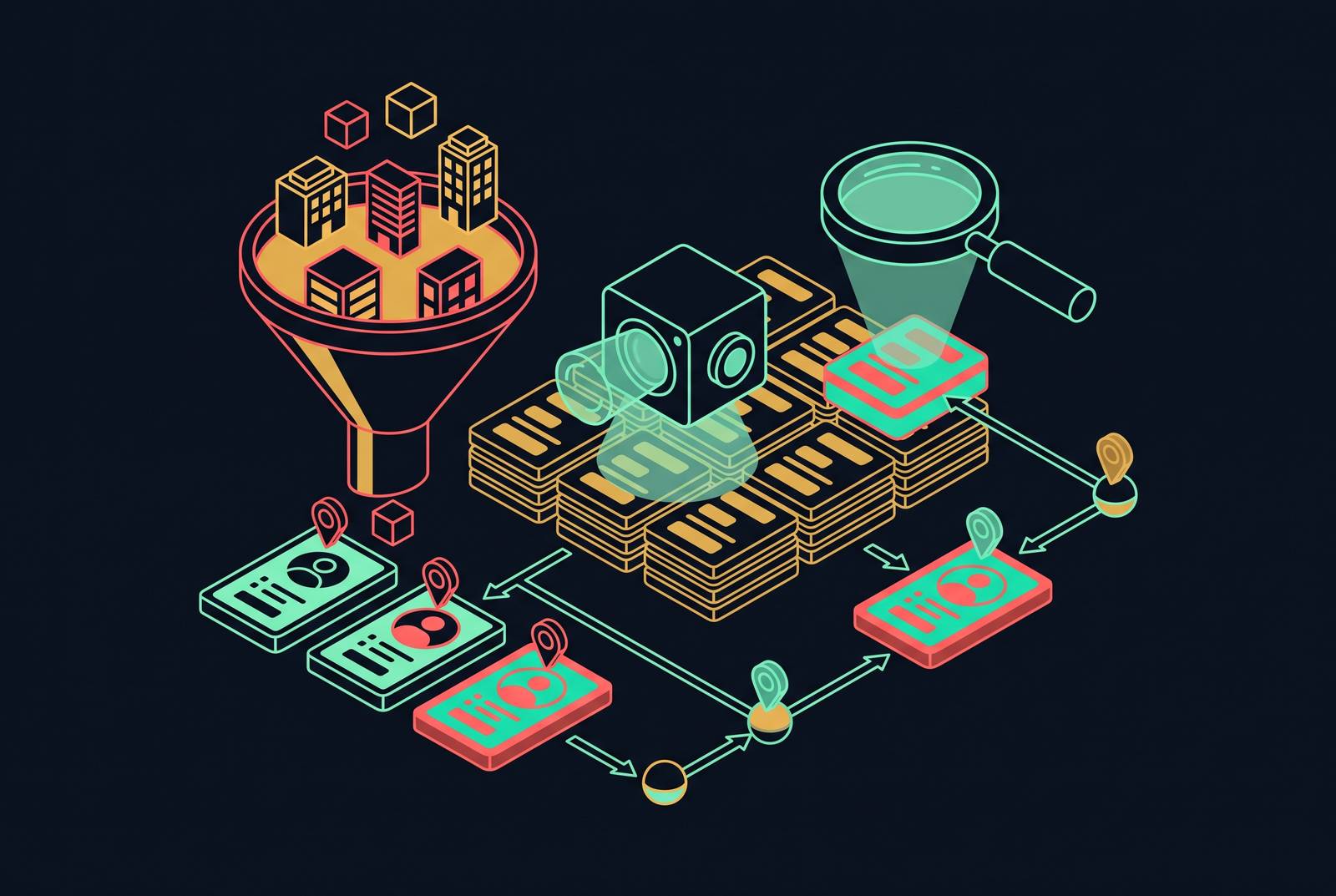
Early-stage B2B founders run into two separate problems when they try to build an ideal customer profile: figuring out who the customer actually is, and finding those customers before they enter a buying window. Most tools on the market solve one problem or the other. Agentic tools, a newer category built to chain live data sources against a plain-language description of a target customer, are the first to address both at once, and this piece walks through why that matters and how to put it to work before product-market fit.
Why static ICP tools fail at the pre-PMF stage
The conventional approach to defining a customer profile relies on firmographics: industry, headcount, job title. That approach no longer tracks how companies actually buy: two companies with identical firmographic profiles can sit at completely different stages of readiness to purchase anything. A profile built this way tells a founder what a buyer looks like on paper. It says nothing about whether that buyer is in motion right now.
Static databases make the problem worse, not better. B2B contact and company data decays at a meaningful clip every year, so a list pulled together in January is materially less accurate by June. That freshness problem is baked into how these databases work, not a coverage gap that better filters could fix.
Founders selling into niche, fast-moving, or newly founded markets get hit hardest. Their ideal customers often sit in a gap that few databases cover, because those companies didn't exist the last time the database refreshed; the Origami prospecting guide notes Apollo and ZoomInfo were architected for stable enterprises, not stealth-mode or sub-20-employee companies. B|A signal-based ICP instead operates on three layers: structural signals for how a company is set up, behavioral signals such as funding rounds, hiring spikes, or tech-stack migrations, and strategic signals for where the company is heading.
A founder ends up holding a well-reasoned ICP definition with no reliable way to find the accounts that match it in real time, and no way to know if the definition itself is even correct, which is the gap the rest of this piece works through.
How signal-based ICPs replace static profiles
The fix starts with a conceptual shift, not a new tool. Moving from firmographic profiles to signal-based ICPs turns customer definition from a one-time worksheet exercise into a live model that updates as new information arrives. This shift is what makes agentic discovery worth using in the first place, because agents need a model that changes as fast as the market does.
A signal-based ICP works across three layers. Structural signals describe how a company is set up (size, org structure, tech stack). Behavioral signals capture timing triggers such as funding rounds, hiring spikes, or a migration to a new platform. Strategic signals point to where the company is heading next. Stacking these three layers means a founder is asking whether a company is demonstrably in motion right now, not just whether it matches a profile.
The stakes of getting this right are measurable. Research on B2B sales performance shows that companies running well-defined, dynamically updated ICPs tend to post higher win rates than companies relying on static, manually built profiles, largely because AI-built profiles update continuously as the customer base shifts and new signals surface. That single finding reframes the whole challenge. Prospecting in 2026 is primarily a timing problem, not a discovery problem, and timing is what a static list can't capture.
What agentic tools do that databases cannot
Signal-based ICPs need infrastructure that can watch multiple live sources at once and judge, in real time, whether a given company matches a plain-language description of an ideal customer. Agentic tools are the first category built to do that at scale.
The difference from a database is architectural: a database returns rows that match a filter. C|This is architecturally different from filtering a database: the agent decides where to look, Crunchbase for fundraising, job boards for hiring signals, GitHub for technical cues, local press for EU-based companies, and chains those sources on the fly. A filter can only ever surface what's already sitting in a table. An agent can go find something that isn't in any table yet.
Adoption of this approach still lags what the technology can do. In the B2B ecommerce sector, Deloitte data found fewer than a quarter of B2B suppliers had used agentic AI in the selling process. That gap cuts both ways: it means most competitors aren't there yet, and founders who move now get a real window before the category catches up. Paul do Forno of Deloitte frames the successful path as targeting specific friction points rather than trying to replace an entire workflow in one move, and that's a useful filter for founders sizing up which agentic tool to adopt first. Founders should identify which single bottleneck, prospecting, qualification, interviewing, is worth solving first.
The two-tool starting stack for solo founders: Clay and Perspective AI
For a solo founder pre-PMF, the most defensible starting stack is Clay for ICP enrichment paired with Perspective AI for the conversation layer, addressing both parts of the ICP gap without requiring a technical ops team.
The logic is a division of labor. Clay builds and scores the list; Perspective AI runs the conversations that confirm or revise the ICP definition itself. The Perspective AI customer discovery guide states that together, the pairing compresses work that would otherwise take weeks into a fraction of a founder's week.
Clay handles enrichment and scoring, evaluating prospects against a natural-language ICP description and scoring each one 1–10 with reasoning per record, a setup faster than formula-based scoring. Dvin Malekian, founder of WarmLeads.io, used Clay's Claygent feature to pull recent hires from target companies, sort each business as B2B or B2C by reading full website content, check whether a company ran on HubSpot or Salesforce by scanning its BuiltWith page, and surface client names from case studies, all without running a single manual Google search. Clay's Launch plan is priced for a solo GTM operator enriching a limited number of contacts each month, and one large enrichment run can burn through the credit ceiling, so founders should size their expected list against the plan before committing. The scoring itself carries a trade-off: AI scoring handles soft, judgment-based criteria well, but it's opaque, and when a prospect scores high and doesn't convert, the reasoning behind that score isn't always recoverable. Teams that need to audit their scoring logic have pre-built alternatives in Cleanlist and MadKudu, which keep criteria explicit rather than inferred.
Perspective AI covers the conversation and synthesis side. It ranked first for solo founders operating in what the Perspective AI 2026 customer discovery ranking calls "100-day mode," and it's the only tool in that ranking that owns the entire conversation layer, from outreach link to themed report. A founder can send one Perspective link to a Clay-enriched list and let AI agents run text and voice interviews across time zones without sitting on a single call, which lets a solo operator realistically complete a large volume of interviews in a week. What separates this from a survey is the probing, visible in the numbers: the AI follows up on vague answers and pulls out specific examples that a dropdown menu would have flattened into a checkbox. Founders running discovery in 2026 complete a meaningfully higher volume of interviews per round than was typical in 2022, a shift that traces directly to AI moderation removing the scheduling friction and synchronous-time cost that used to cap how many interviews a founder could physically run. Pricing starts free, moving to conversation-based usage tiers from there. It isn't built for everything adjacent to interviewing: it's not a usability testing platform like Maze or UserTesting, and it's not a panel marketplace like Respondent or User Interviews, so the founder still has to supply the list of people to talk to.
The broader tool landscape: conversational agents vs. workflow platforms vs. static databases
The market for agentic prospecting in 2026 splits into three distinct camps, and each fits a different kind of founder. Picking the wrong camp entirely is a far more common and costly mistake than picking the wrong tool inside the right one.
Conversational AI agents, including Origami and Bardeen, win with startups and small teams because they need no technical setup and run from a single plain-language prompt. Speed to a first usable list gets measured in minutes rather than days. Origami takes a prompt like "Find CFOs at private equity-backed software companies in Texas," searches the live web, chains its data sources, enriches the resulting contacts, and qualifies leads automatically, returning verified emails, phone numbers, and company details; the Origami prospecting guide states the free plan includes 1,000 credits with no credit card required, and paid plans start at $29 a month. Because it searches the live web rather than a static index, Origami surfaces recently funded startups and new hires that traditional databases miss outright, a real advantage for any founder whose ICP skews toward young or fast-moving companies. It stops short of pipeline management: closed deals still need to move into the founder's own CRM. A separate test aimed at European AI agent prospecting, described in the Origami guide, ran a single prompt and returned 150 verified contacts across Berlin, Paris, and Stockholm-based AI agent startups, contacts that didn't show up with complete data in the static databases checked against the same test.
Workflow automation platforms, Clay, Make, and Zapier among them, win with mid-market and enterprise sales ops teams that have a GTM engineer or technical operator on staff to build and maintain multi-step data pipelines. Clay is the clearest example of the category's strength and its cost: it handles custom enrichment logic and data waterfalling well, but using it well means knowing which API endpoints to chain together. One defense contractor sales leader, quoted in the Origami prospecting guide, described finding Clay "a little overwhelming" and said he didn't want to spend the time learning it. Clay's free plan caps monthly actions, and paid plans start at $167 a month per the comparison table in the Origami guide (pricing worth confirming directly before acting on it, since plan structures shift). This camp is the right call when a founder has a technical co-founder or ops hire on the team, the enrichment logic is genuinely complex and custom, or the team is already running outbound at real volume.
Static databases, Apollo, ZoomInfo, RocketReach, Hunter.io, and Lusha among them, remain useful for what they were built to do. Apollo offers a free limited plan and a $49-a-month annual tier, with a strong contact database and built-in sequencing, though it struggles with stealth-mode or very new companies and its contact freshness lags for fast-changing startups. The Origami comparison table shows ZoomInfo has no free plan and runs roughly $15,000 a year, delivering enterprise-scale org charts and intent data, but its coverage of sub-20-employee companies and niche tech is thin. Hunter.io offers a free plan with a limited monthly credit allowance and a $34-a-month annual tier, and it's built for confirming email patterns at companies a founder already knows about rather than discovering new ones. The Origami European guide notes Lusha's free plan carries a limited monthly credit allowance with paid plans starting at $49 a month, useful for quick individual contact lookups through its browser extension. Every database in this camp shares the same structural limit: they're built around contacts and refresh on a fixed schedule, so any ICP that skews toward companies that are recently founded, niche, or moving fast will be underserved no matter which specific platform a founder picks.
Beyond prospecting sits a wider discovery stack, problem validation tools like Maze and UserTesting, interview repositories like Dovetail and Notably, panel sourcing platforms like Respondent and User Interviews, and synthesis tools like Notion AI. The Perspective AI 2026 customer discovery guide maps all six layers of that stack. Those tools sit outside the scope of this piece; they're follow-on investments once an ICP has actually been validated.
The hallucination and garbage-in risks founders need to manage
The real risk in an agentic ICP workflow is that the system produces answers that sound entirely plausible and are wrong, and those wrong answers compound as they move through the rest of the discovery process.
Multi-step agentic workflows are especially exposed to this. A hallucination introduced at step one gets treated as established fact by step five. Microsoft Research's VeriTrail paper, first posted in May 2025 and later published at ICLR 2026, makes the case that detecting hallucination in agentic workflows requires tracking provenance at every individual step, precisely because errors don't stay contained. They propagate forward through the chain.
The input side carries its own version of the same risk. Mercury's GTM guidance holds that the strongest AI outputs come from real human inputs: customer interviews, demo recordings, onboarding calls, post-mortems on deals that fell through. Founders should not feed call transcripts from prospects that were a bad fit into the system to begin with. Agents amplify whatever gets fed into them; they don't substitute for a founder's own judgment about which inputs are worth trusting in the first place.
Clay's scoring illustrates the trade-off directly. It's faster to set up than a formula-based system, but harder to debug: when a prospect scores high and doesn't convert, the reasoning behind that score often isn't recoverable. Founders who need to audit their scoring logic have transparent alternatives in Cleanlist, MadKudu, and 6sense.
One data point deserves a caveat before it gets used as evidence of anything. Perspective AI's State of AI Customer Interviews report found that teams cited "moderation cost" as their biggest unlock, a self-reported figure from Perspective AI's own research that should carry proportionally less weight than an independent study would.
None of this argues against using agentic tools. It argues for a specific discipline: treat every agentic output as a hypothesis, not a conclusion, and build the workflow so AI-generated findings get checked against human-validated interview data before any ICP definition gets locked in.
Putting it into practice: a pre-PMF ICP workflow in three phases
The workflow that follows from everything above runs in three phases, each one feeding the next.
The first phase is drafting a signal-based hypothesis rather than a firmographic checklist. F|That means writing down the structural, behavioral, and strategic signals a founder expects to see in a real buyer, in plain language, specific enough that an agentic tool can act on it directly, chaining heterogeneous live data sources against that description in real time.
The second phase is running that hypothesis against a live list and testing it against real conversations, not just against a spreadsheet. A founder builds an enriched, scored list through Clay, then routes that list straight into Perspective AI to run interviews that either confirm the signals chosen in phase one or reveal that they were pointing at the wrong companies entirely.
The third phase is treating every output from that process as provisional until a human has looked at it. Scores get checked against actual conversion outcomes, interview transcripts get read rather than skimmed, and the ICP definition itself gets revised as new signals turn up, because the whole point of a signal-based model is that it keeps moving with the market rather than freezing the moment it's written down.
Sources
- How B2B ecommerce companies can prepare for agentic AI discovery
- Best AI Tools for Founders Doing Customer Discovery in 2026: 10 Platforms Ranked | Blog | Perspective AI
- Best AI Prospecting Tools for B2B Startups (2026 Guide)
- Prospect Agentic AI Startups: Tools & Tactics (2026) - Origami
- European AI Agent Companies Leads: Best Tools 2026 - Origami
- How to Find Your ICP in 2026: AI Tools & Tactics - Origami