Breakup Email Tactics That Recover Stalled Outbound Threads
Withdrawal from prospects triggers replies more reliably than persistent pressure ever does.

Most sales teams treat the breakup email as a formality. The prospect ignored emails one through four, so the rep sends a polite goodbye and moves on to the next account. The data says this is backward: the breakup email is frequently the highest-performing message in the entire sequence, outperforming the four or five emails that came before it. The reply does not come from better writing. It comes from a change in posture: every prior follow-up kept the pressure on, while the breakup email takes it away entirely, and that act of withdrawal is what moves a silent prospect to respond.
The three psychological mechanisms that make withdrawal trigger a reply
Three mechanisms converge in a well-built breakup email, and each one does something that the earlier follow-ups could not do. The first is loss aversion: once a prospect faces the real possibility that an offer is going away, the cost of losing it registers more heavily than the cost of having ignored it ever did. The second is reactance: when a freedom is threatened or taken away, including the freedom to keep the option open, people feel a pull to reclaim it, an impulse that a polite, pressure-maintaining follow-up never creates because it never actually threatens anything. The third is the Zeigarnik Effect, a documented cognitive bias in which people feel discomfort around unfinished business; it activates the moment a prospect reads a line like "this will be my last email," and combined with loss aversion, it is what tips a silent prospect into action. These three mechanisms stack on top of each other. Loss aversion gives the prospect something to care about losing, reactance makes them want to reclaim control of the decision, and the Zeigarnik Effect makes leaving the thread hanging feel uncomfortable enough to resolve.
Where the breakup email belongs in the sequence
The breakup email only works if the prospect has already been courted. Reactance and loss aversion both need the prospect to have felt, at some point, that something real was on offer, so if you fire the breakup email too early, you withdraw an offer the prospect never registered. It belongs at the end of the campaign, after the earlier steps have run their course, and the sequence should pause automatically the moment a prospect replies at any earlier stage. HireEmma's 2026 benchmarks put four to seven emails as the range supported by the largest available dataset, which makes the breakup email a natural final position within that window. The spacing leading up to it matters as much as the position itself: a cadence that starts tight and widens gradually mimics how an actual person follows up, and it avoids the identical-interval pattern that spam filters are built to catch. Done right, the breakup reads like a considered decision, not another reflexive send. If a prospect showed real engagement earlier, such as opening emails or sitting through a demo, you can move faster to the breakup, because the relationship's actual stage should set the pace more than any fixed email count.
The 2026 Deliverability Environment and the Case for the Breakup Email
Sending to unresponsive contacts indefinitely no longer just wastes a rep's time. It actively damages the sending domain's reputation, because mailbox providers now weigh engagement signals more heavily than IP reputation alone when they decide where a message lands. Gmail began rejecting non-compliant emails outright in November 2025, instead of routing them to spam, and Microsoft brought the same kind of enforcement to Outlook.com in May 2025. Instantly's 2026 benchmark report found that deliverability now matters more to how a campaign performs than subject line quality or body copy does. That enforcement environment turns the breakup email into part of a sunset sequence: one last high-value touch before suppression, built to protect the domain's standing with the filters rather than burning further sends on contacts who were never going to reply. Confirming inbox placement, contact accuracy, and engagement history before sending the breakup protects the final touch, keeping it a clean exit and avoiding a negative signal.
The subject line's job: signaling finality without manufacturing false urgency
A breakup email's subject line has one job: tell the prospect that something is ending, without sounding like a stunt. Smartlead's templates show what works here. "Should I close your file?" signals finality without aggression, and it hands the prospect explicit permission not to reply, which, counterintuitively, raises the odds that they will, since the feeling of being cornered disappears. "Quick question before I move on" and "Closing the loop" work on the same principle at the subject-line level: each one opens a loop that the Zeigarnik Effect makes the reader want to close. The directness that makes these lines work resembles the signal-reference approach used in high-converting cold email subject lines generally, except the breakup line doesn't need an external trigger event to earn its place in the inbox, and it earns attention by naming the ending.
Three body copy approaches, matched to what the prospect's silence means
Silence means different things for different prospects, so the body copy should match the likely cause. A prospect with zero engagement history, who never opened an email or clicked a link, calls for the standard close: Smartlead's template acknowledges the prior outreach, states that the file is closing, and leaves the door open without applying pressure. The phrase "close your file" does the heavy lifting: it signals finality without hostility, and giving the prospect permission not to respond is what makes a response more likely. Brevity matters as much as the wording. The email runs two to three sentences, noticeably shorter than the initial outreach, because any more content starts rebuilding the pressure the breakup exists to remove.
A different silence, where the prospect simply may not be the right contact, calls for the referral pivot. Smartlead's template under the subject "Quick question before I move on" asks for a name rather than a meeting, which turns the ask from "will you buy" into "can you point me to the right person." That is a much smaller request, and it tends to reactivate prospects who were never the buyer. The ask works because it removes the weight of obligation: the prospect isn't being asked to decide anything, just to redirect, which lowers defensiveness considerably.
A third kind of silence, from a prospect who showed real interest earlier and then went quiet, calls for the value-add exit. Smartlead's template under "One thing before I go" leads with something useful, a case study, an ROI calculator, or benchmark data, before mentioning that outreach is ending. Leading with value on the final send reframes the whole sequence: even a prospect who never replied walks away with something, and the sender reads as credible. This approach lands best when the sequence has already delivered real content earlier, so the final gesture feels consistent with the relationship. A fourth variant is the diagnostic close, which asks the prospect to pick a reason the deal stalled (not interested, bad timing, already has a solution, interested but lacking budget) through a simple lettered reply format. It works best on prospects who engaged earlier and then disappeared, because naming that history directly sharpens the Zeigarnik Effect.
How the call to action converts the psychological mechanisms into a reply
A strong subject line and well-matched body copy can still fail at the last step if the CTA asks for too much. The call to action in a breakup email has to make replying the easiest possible thing to do, not another commitment layered on top of everything the prospect already ignored. Effective breakup email CTAs strip away every ask except a binary one: reply or don't. Anything that requires scheduling a call, making a decision, or committing to a next step brings back the exact pressure the rest of the email worked to remove. For senior buyers specifically, a one-line push performs well on its own: extreme brevity and directness suit prospects who are tired of long sales emails, and when the message is short enough, the entire email functions as the CTA. But remember that a negative reply still counts as a win. It clears the CRM of a dead lead, protects the domain's deliverability by ending contact with someone who was never going to engage, and occasionally opens a conversation the prospect would never have started on their own.
Multi-channel amplification of the breakup email
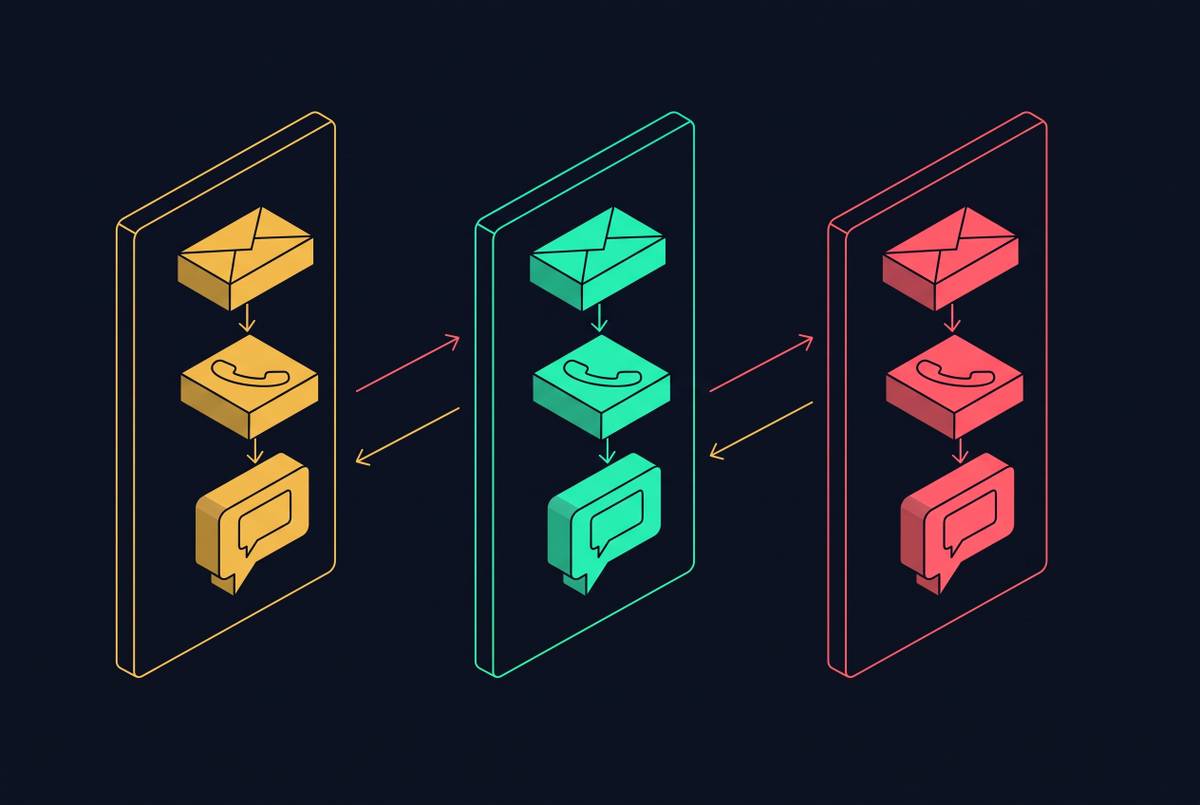
The psychological effect of a breakup email gets stronger when the same signal reaches the prospect through a second channel on the same day. Combining the breakup email with LinkedIn outreach produces a measurably bigger impact than sending the email alone, and the combination reads as coordinated persistence rather than harassment, provided it's handled correctly. The pattern that works: send the email, follow that same afternoon with a LinkedIn connection request or InMail that references it directly, and optionally close with a brief voicemail confirming that outreach is ending. Each channel should reinforce the same finality signal, not repeat the sales pitch in a new format. The mechanism at work isn't persistence for its own sake, it's coherence: seeing the identical "closing your file" message land across two or three channels makes the withdrawal feel more concrete, which deepens the loss aversion already at work. Decision-makers respond better when a message references something specific and current, so the LinkedIn message works best when it points to a real signal, a post the prospect made or a company announcement. This tactic has a clear limit: a prospect with no prior engagement at all, who never opened an email or interacted with any touch in the sequence, is more likely to read a coordinated multi-channel push as pressure than as a graceful close.
The strongest objection to breakup emails
The breakup email is not a universal fix, and treating it like one is the surest way to misuse it. The strongest objection is a survivorship problem: the breakup email only reaches people who ignored every prior touch, so its audience is already filtered down to the hardest cases, and its reply rate can't be compared directly to earlier sequence steps without accounting for the fact that the most engaged prospects already replied and left the sequence. A second limit sits in the ending itself: a prospect who doesn't reply now hasn't necessarily closed the door forever. Smartlead's templates leave it open explicitly, with lines like "feel free to reach out anytime" that turn the breakup into a pause. A third limit is context. The three mechanisms work hardest when the prospect had some genuine interest at some point; for a contact who was never engaged at all, loss aversion has less to work with, because there's less perceived value on the table. Reviewing engagement history before choosing a template accounts for all three limits at once: the diagnostic close belongs with prospects who engaged and then went quiet, the standard close belongs with prospects who never engaged, and running them in reverse order wastes the one send built to count the most.
Putting the mechanics together: what a well-constructed breakup email does to a stalled thread
A breakup email that works is a deliberate withdrawal, built so that loss aversion, reactance, and the Zeigarnik Effect fire across every part of the message. The subject line opens the loop the Zeigarnik Effect exploits, the body copy signals a real ending without applying pressure. Loss aversion and reactance do their work there, the CTA keeps replying as close to effortless as possible, and the multi-channel echo makes the withdrawal feel concrete enough to move a prospect who has stayed passive through everything else. A rep who understands why each piece works can adjust on the fly: a senior buyer who ignores a standard close might answer a one-line push, a mid-level contact who attended a demo and then disappeared is a strong candidate for the diagnostic close, and a contact who was simply never the right person becomes a referral opportunity. None of this depends on guesswork about who's still paying attention. You have to read engagement history correctly and time the final signal to match what that history shows.