DNC Registry Compliance for Phone-Based Outbound Sales
Compliance requires three lists working in parallel, not a legal checklist.
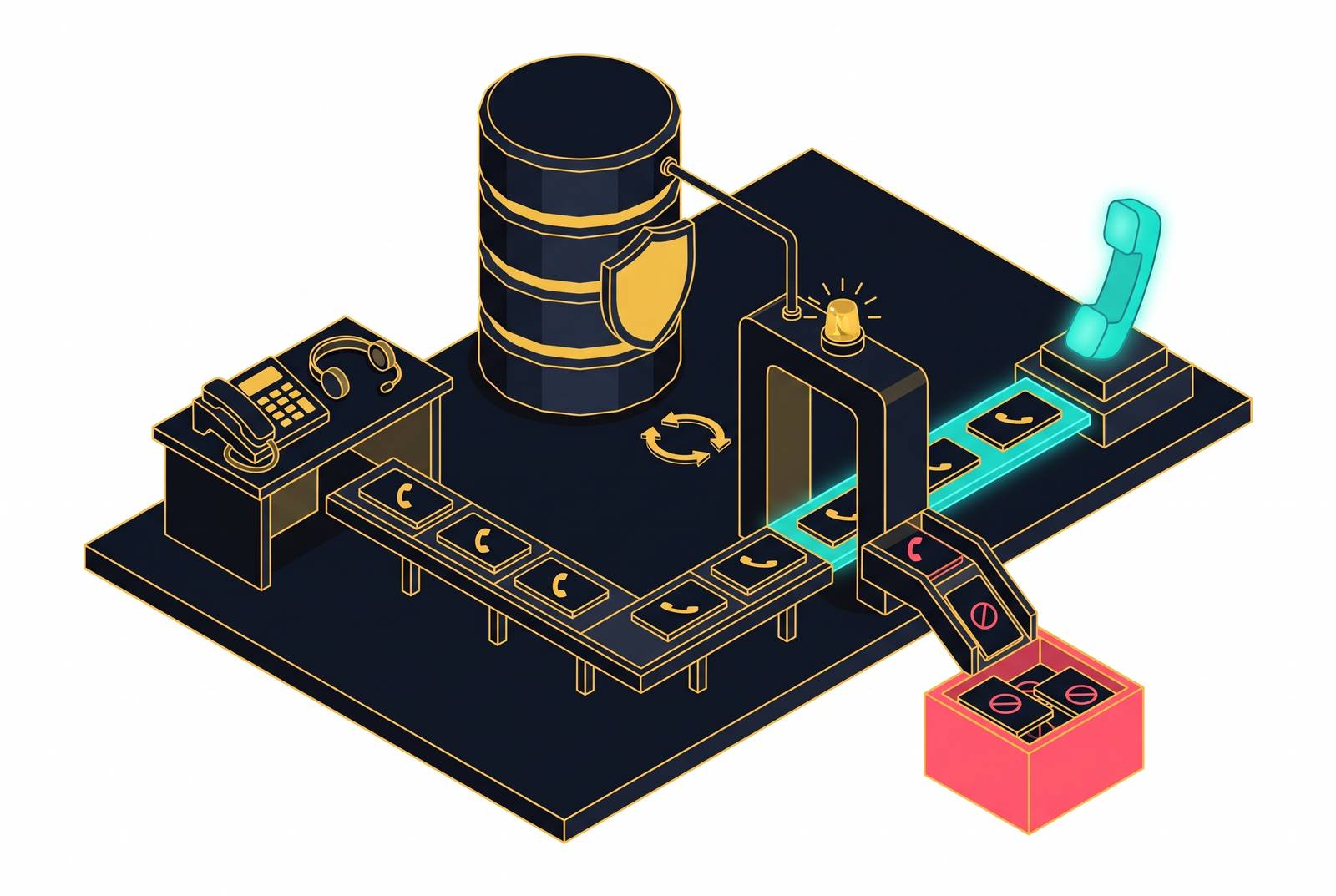
DNC Registry compliance for phone-based outbound sales is an ongoing operational discipline. A defensible program keeps federal and state registry checks, consent documentation, and internal suppression working in parallel on every campaign. Those controls must stay connected as records, vendors, and rules change.
Why DNC compliance is an operational system, not a legal checklist
A rep dials from a list exported six weeks ago. The consumer previously opted out through a different phone number, but the contact record containing that request was deleted. A CRM import has since restored the contact without the suppression history. The rep sees no warning and makes the call. This is a system failure that can occur even when the rep knows the rules.
Federal scrubbing, state scrubbing, and internal suppression must each stay up to date, with proof of what happened before a given call. FTC civil penalties can reach tens of thousands of dollars per violation, while private TCPA damages are $500–$1,500 per call with no limit on the total. State penalties can add thousands of dollars for each call. A legal review completed in 2023 cannot establish that today’s workflow reflects the changes made in 2024–2026.
The two federal frameworks that govern every outbound sales call and why both apply at once
The FTC’s Telemarketing Sales Rule, or TSR, and the FCC’s Telephone Consumer Protection Act, or TCPA, create separate compliance tracks. The TSR supplies federal telemarketing and DNC obligations. The TCPA, at 47 U.S.C. § 227, governs autodialed calls, prerecorded and AI-generated voice messages, texts, and consent requirements. It also permits individual consumers to bring private actions without waiting for a regulator. Satisfying one framework does not satisfy the other.
The distinction affects campaign design, especially for mobile numbers. Valid consent to text a consumer under the TCPA does not, by itself, authorize a sales call to a registered number under the TSR when no exemption applies. Both frameworks limit calling hours to 8 a.m.–9 p.m. in the recipient’s local time, and TCPA abandonment limits apply to each campaign over a rolling period. Against this established architecture, 2024–2026 brought more regulatory movement than the prior decade.
What changed in 2024–2026 and what is still unsettled
The FTC’s 2024 TSR amendments expanded recordkeeping requirements, including five-year retention for certain entity-specific DNC and registry-related records. Those requirements are now in force and replace the previous 24-month standard for the records they cover. The FCC’s consent revocation rules partly took effect on April 11, 2025, requiring prompt handling of opt-outs by “any reasonable means.” The broader requirement for one revocation to stop all robocalls and robotexts from the same sender was delayed until January 31, 2027.
The FCC adopted FCC 26-67 on September 30, 2026, which changes the revocation rules further. Once effective, it allows an opt-out from one informational category to remain within that category and permits callers to designate one or more disclosed revocation methods. Its effective date depends on Federal Register publication and a later FCC Public Notice confirming the date. The adjustment supersedes the January 31, 2027 revoke-all date when it takes effect. Teams must therefore keep track of revocation requirements even with the deadline pushed back.
The one-to-one consent rule has a different status. The Eleventh Circuit struck it down on January 24, 2025, after its postponement earlier that month. The FCC formally removed it in July 2025, effective August 29, 2025, reinstating the prior written-consent standard. Current programs should not be built around the vacated rule.
The FCC’s offshore call center proposals are not binding requirements. FCC 26-16, released March 27, 2026, proposes caps on foreign handling of customer service calls and disclosures identifying the country and the right to request a U.S.-based representative. Companion proposal FCC 26-17 addresses anti-robocall measures tied to foreign call centers. The proceeding asks for comments on whether the requirements should also cover TCPA-covered calls, which could include outbound sales. As of October 11, 2026, it remains a proposal that offshore outbound teams should monitor.
The three lists every outbound team must manage in parallel
The National Do Not Call Registry requires recurring screening against current data. Federal scrubs must be no older than 31 days, and download receipts provide evidence of the data used. Registration obligations do not disappear because a business is small or calls infrequently. An undated scrub cannot support a defensible campaign record.
Teams must also screen against the state registries that apply to their calls. Access to the federal list does not give teams access to state lists, which have their own registration and access fees. Colorado, Indiana, and Pennsylvania require quarterly scrubbing on a separate schedule from the federal cycle. State attorneys general enforce independently, so the same call records can support state and federal actions. Florida and Texas present particularly active enforcement environments for high-volume callers.
The internal company DNC list needs the most care in day-to-day work. It captures requests from any channel, with a timestamp and source, and must preserve them for the required retention period. Number-only suppression leaves a gap when a contact has several numbers. Contact-level suppression closes it by applying the opt-out across the associated numbers.
When a CRM sync restores a contact without its opt-out history, a rep can dial in good faith and still produce a violation. Good intent does not restore the missing control. Financial services, recruiting, real estate, and healthcare are especially at risk because their contact records often have more than one number and are used to reach people again over long periods.
Exemptions from the DNC Registry prohibition and the documentation they require
Established business relationships and express written consent can permit calls otherwise prohibited by registry status. They require evidence. A transactional established business relationship, or EBR, lasts 18 months after a transaction, while an inquiry-based EBR lasts 3 months after an inquiry about the seller’s goods or services. Each requires a timestamp, a record of the qualifying event, and a link to the consumer. A transaction from 19 months ago supplies no valid EBR exemption.
Express written consent must be prior, written, and specific to the seller. Its documentation must identify the consumer and seller, and consent for one purpose does not authorize unrelated sales calls. Other exemptions have narrow boundaries. Charities calling on their own behalf are exempt from federal DNC requirements, although state laws may be stricter. Survey and research calls lose their exemption when a sales pitch is introduced.
The B2B exemption is real but not blanket protection. Federal DNC rules generally exempt business-to-business calls, with the exception of nondurable office or cleaning supplies, but a business contact’s direct dial may be a registered personal mobile. Sole proprietors, home-office workers, contractors, consultants, and franchisees can appear on SMB lists as residential subscribers. State treatment also differs, including broader provisions under Florida’s Telephone Solicitation Act. Massachusetts, by contrast, does not extend its state DNC protections to business numbers, including sole proprietors’ business lines.
How vendor and lead-gen relationships extend your liability beyond your own dialers
A seller’s exposure extends to lead generators, telemarketers, and call center vendors acting on its behalf. The FTC’s case against Citizens Disability, LLC, filed September 30, 2025, illustrates that reach. The FTC alleged that Citizens Disability and its subsidiary CD Media placed more than 109 million outbound calls between January 2019 and July 2022, including calls to registered numbers. It also alleged that websites offering prizes, coupons, and other services collected personal information used for tens of millions of illegal sales calls through call centers and third parties. The allegations put the seller’s responsibility for partner conduct at issue.
The proposed order makes vendor oversight an explicit obligation. It includes a partially suspended civil penalty, payment within the year after entry, bans on certain robocalls, prohibitions on further DNC violations and misrepresentations, and oversight of lead generators. Its significance is the reach beyond in-house dialing. Liability for assisting and facilitating violations makes lead sourcing part of the compliance system.
For outsourced programs, the practical response is contractual compliance warranties backed by independent audit rights. Vendors should demonstrate the same scrubbing cadence, consent documentation, and suppression practices expected internally. Self-reporting alone cannot establish that those controls work. Indemnification shifts costs after a violation but does not prevent enforcement against the seller.
Building the scrubbing and suppression workflow that actually holds up in an audit
To audit an outbound program, begin with registry access and the recurring scrub job. Register through the federal registry’s telemarketing portal, select the area codes the team will call, download full lists at the start, and keep applying updates. Schedule scrubbing as a system job with a confirmation log. Record the date, data source, records checked, records removed, and responsible person or system. Calendar each state’s cadence separately from the federal 31-day cycle.
Real-time checking is a voluntary risk decision. The recurring federal cycle permits calls using a compliant scrub even when a number was added to the registry later in that window. Pre-campaign or point-of-dial checking reduces exposure to those intervening registrations. Real-time API-based screening can therefore strengthen the workflow without being represented as a legal requirement.
For internal suppression, apply an opt-out to every number associated with the contact. Automate the update when the request arrives, rather than waiting for the end of a shift or a manual import. Check new CRM records against the internal DNC list before adding them to a dialing queue. Keep internal DNC records for at least five years. This control must keep working when a contact is deleted and re-imported.
For calls relying on consent or an EBR, preserve the authorization evidence with equal care. EBR records should show the relationship’s date, nature, and expiration, while consent records should capture the method, date, disclosure, consumer, and seller. Neither body of evidence should depend on reconstruction after a complaint. A scrub proves screening alone.
An integrated platform can reduce gaps between these controls. RevRing connects communication tools, CRM systems, automation, and compliance functionality in one revenue acceleration ecosystem, illustrating the architecture while evidence remains necessary. A suppression record invisible to the dialer cannot prevent a call. Whatever stack is used, the audit test is whether a compliance officer can retrieve the relevant scrub log, suppression status, and consent or EBR documentation for a dialed number on a given day.
How coverage, exemptions, and enforcement priorities differ across industries
Insurance, financial services, mortgage, real estate, healthcare, and lead generation combine several recurring sources of exposure. High call volumes increase the consequences of stale data. Multi-number records complicate suppression, while long re-engagement cycles allow EBR windows to expire before records are updated. Regulation by state insurance authorities, FINRA, or the OCC does not itself create an exemption from FTC and FCC DNC rules. Small insurance agencies must also follow the outbound rules that apply to them, whatever their size.
Real estate and home services place residential cold calling at the center of customer acquisition. Home security, solar, and HVAC programs also often rely on third-party lead generators, so the controls must reach beyond the seller’s own records. Lead-generation businesses face obligations both as telemarketers and as entities that assist and facilitate violations. Nominally B2B teams face a different version of the same problem when SMB lists contain personal mobiles and residential subscribers.
Why ongoing monitoring of the regulatory environment is itself a compliance requirement
Even a well-connected workflow can become outdated when rules change. The broader recordkeeping rules in 2024 and revocation changes in April 2025 required teams to update how they work, and FCC 26-67 adds another timeline for putting changes in place. The vacated one-to-one rule shows that a planned requirement can disappear. Teams need to watch the offshore proposals while treating them as proposals. Monitoring must distinguish adoption, effectiveness, delay, and removal.
The practical response is to assign regulatory monitoring to a named person or function with a documented review cadence. Map each change to affected procedures within its implementation timeline, supplementing annual legal review. Evaluate technology vendors partly on how quickly they reflect regulatory changes. Valid consent, accurate DNC handling, and clean data tend to support healthier connection rates and fewer downstream complaints, giving disciplined outbound programs a performance advantage as well as a stronger compliance position.