CRM Contact Data Decay Rates and Enrichment Refresh Cadence
Field-level decay rates demand different refresh schedules, not annual blanket updates.
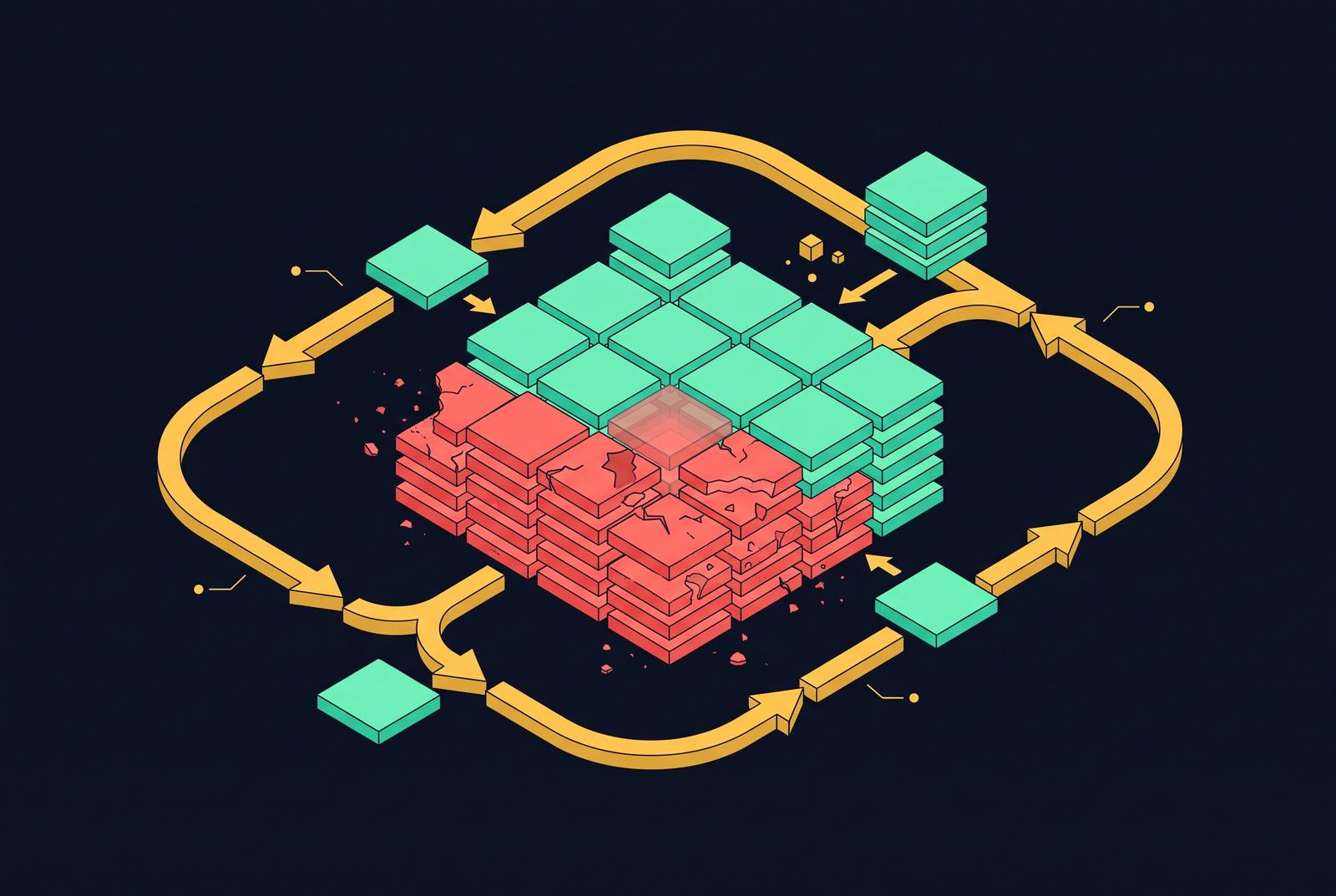
CRM contact data does not decay as a single block. It decays field by field, at materially different speeds, driven by the structure of the labor market rather than by failures of data management. This changes what an effective enrichment cadence looks like, because a refresh schedule that treats every field the same is neither accurate nor efficient.
Why CRM contact data does not decay uniformly across fields
The model most teams operate on is simple and intuitive: data goes stale over time, so clean it once a year. That model collapses the moment the behavior of individual fields is examined. A business email address is tied directly to employment status. It breaks the moment someone leaves a company. A job title shifts with every promotion, reorganization, or lateral move, all without any change in employer. The company name itself changes on acquisition or restructure, independent of the contact's own movement. Industry classification and revenue band are structural attributes that change rarely.
Apollo's own field-level table makes the distinction concrete. Employer warrants continuous, event-triggered monitoring. Job title justifies quarterly or event-triggered refresh. Business email demands at-send verification plus monthly monitoring. Phone requires verification before dial and quarterly re-checks. Mailing address can live on a semi-annual cycle. The spread across these fields is not a matter of degree. It is a difference in kind.
The driver underneath this unevenness is labor-market churn, not data mismanagement. The Bureau of Labor Statistics recorded 3.2 million quits in a single month in June 2026, and median tenure has fallen to its lowest point in decades. Every departure creates an incorrect record somewhere in someone's CRM. That is a structural input, not a problem that better data entry will solve. Field-level decay is the governing reality, and every decision about refresh cadence has to start from it.
How fast each field actually decays, and what the evidence shows
The range of field-level decay rates spans an order of magnitude. Email addresses lose validity at several percent per month. Industry classification remains stable for years. The single blended figure that dominates vendor marketing obscures this range rather than explaining it. A blended annual rate of roughly 30% for full contact records, a figure Keepsync's 2026 analysis converges on with the broader industry, tells a CRM owner almost nothing about what to refresh next week.
Phone numbers sit in a middle band. A meaningful share become invalid within a year as lines are disconnected or reassigned. Employer and company name changes are event-driven rather than time-driven: triggered by acquisition, layoff, or restructuring. They need continuous monitoring, not quarterly batch updates, because no fixed calendar predicts them. Mailing address changes on office relocation, which is infrequent enough that semi-annual verification is sufficient. Industry classification and revenue band shift only on major firmographic events.
The annual snapshot has a second blind spot. It misses churn that happens and reverses within the same year. A contact who changes roles and returns to the same company, or moves twice, appears stable in a year-end comparison. If you re-verify weekly, you surface a materially higher effective decay rate than annual measurement because it catches transient changes the snapshot method cannot see. The blended annual figure is not wrong, but it is an average that flattens the very signal a refresh strategy needs.
Decay also varies by seniority and industry. Median tenures are short in technology, so contacts there decay faster than average. Healthcare and financial services decay more slowly. These differences mean the cadence framework in the next section is a decision tool, not a rigid prescription. A team selling into enterprise healthcare will land on different refresh intervals than one selling into mid-market technology.
What the decay rate gap means for AI tools and scoring models built on CRM data
AI-powered sales and marketing tools amplify field-level decay. They do not absorb it. Model outputs inherit the error profile of whatever fields feed them, and the fields that decay fastest are exactly the ones AI agents act on first. An AI SDR routing outreach on job title will email a contact's old role if title is the stale field. It will contact a departed employee if email is the stale field. The failure is not the model's. It is the input's.
The asymmetry extends to scoring. Models that weight firmographic signals such as company size, industry, and revenue are more durable than models that weight role-level signals, because the fields they depend on decay at different speeds. Intent signals are the most volatile data type of all, warranting real-time or near-real-time monitoring. A model acting on week-old intent is not acting on intent in any useful sense.
Apollo's guidance frames data hygiene as a prerequisite for AI-powered outbound, not an afterthought. You cannot trust the agent layer until the enrichment layer is in place. The organizational consequence of getting this sequence wrong is severe. When AI outputs are visibly wrong, when they email departed contacts or score stale accounts, CRM trust collapses faster than it would from human error alone. The volume of AI-generated outreach means errors scale. A hundred bad emails from a rep were an embarrassment. A hundred thousand from an agent are a deliverability and reputation event.
How field decay velocity maps to a practical refresh cadence
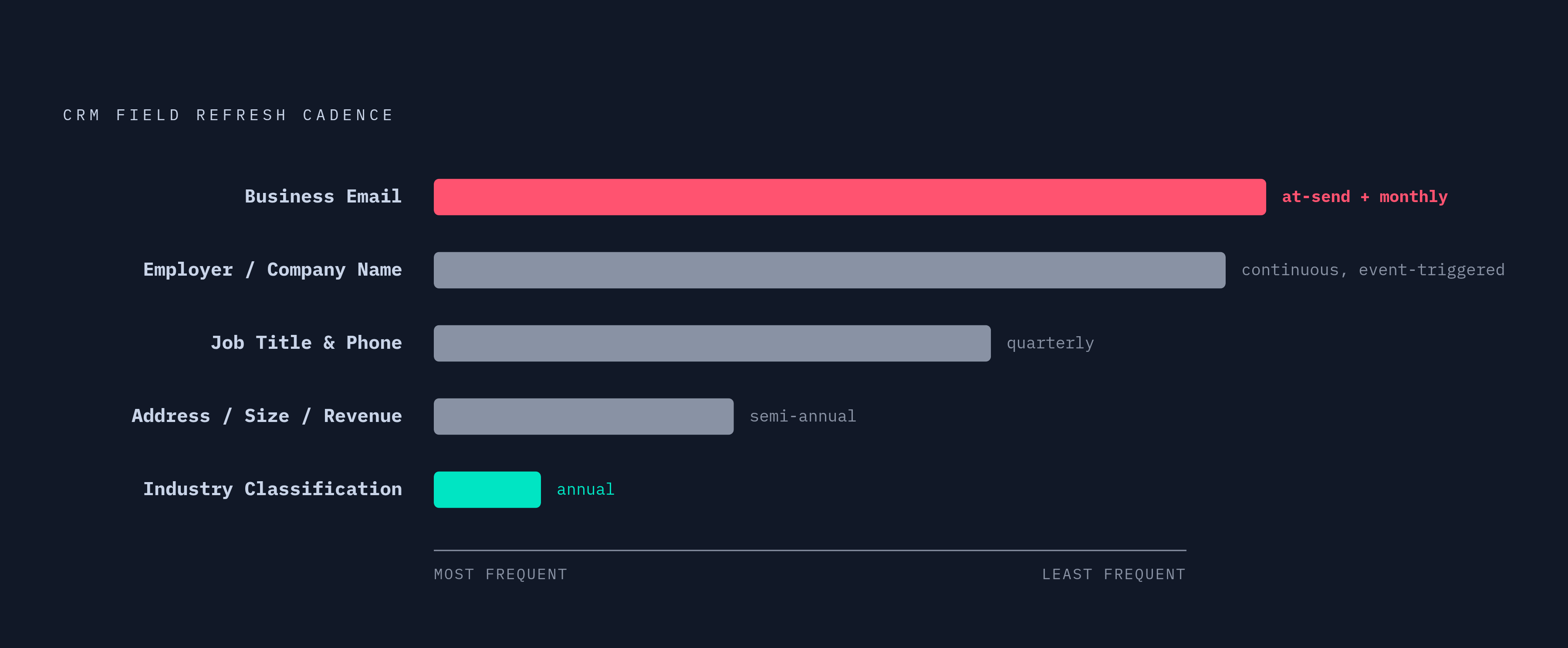
A refresh cadence mapped to field decay velocity is both more accurate and more efficient than a single annual or quarterly sweep, because it concentrates enrichment spend on the fields that actually need it. The tiered framework falls out of the decay behavior itself. Employer and company name warrant continuous, event-triggered monitoring, because they change on discrete, detectable events such as job-change signals, acquisition announcements, and funding rounds rather than on a calendar. Job-change alerts serve a dual purpose: risk management, since the contact is no longer reachable at the old company, and opportunity creation, since a champion moving to a new account is a warm introduction.
You need to verify a business email address at send time and monitor the existing base monthly. The cost of a bounce is immediate: deliverability damage and sender reputation. Verification at the moment of use costs less than recovery from a damaged domain. Job title and phone number sit on a quarterly cycle. Their decay velocity makes annual refresh clearly insufficient, but they are not event-driven enough to justify continuous monitoring for most databases. Active pipeline contacts are the exception, because they warrant event-triggered title monitoring rather than waiting for the next batch. Mailing address, company size, and revenue band can refresh semi-annually. Industry classification needs only annual review unless a major structural event such as an acquisition makes a trigger-based update appropriate.
Funnel position adjusts the cadence within each tier. Active pipeline and hot leads should have every cadence compressed: enrich at entry and re-verify on every meaningful engagement signal. You should re-enrich the MQL pool before each routing cycle, not on a fixed calendar. Cold or archived contacts can extend the cadence, since semi-annual is sufficient for records unlikely to be activated soon.
The operational architecture that mature teams converge on is blended. Real-time enrichment handles new inbound records at the moment of entry. Scheduled batch enrichment refreshes the existing base on a field-appropriate cadence. The two modes complement rather than replace each other. A single annual sweep cannot serve the fastest fields, and real-time enrichment of the entire database is an unnecessary expense for the slowest ones.
Why single-provider enrichment cannot sustain a field-level cadence
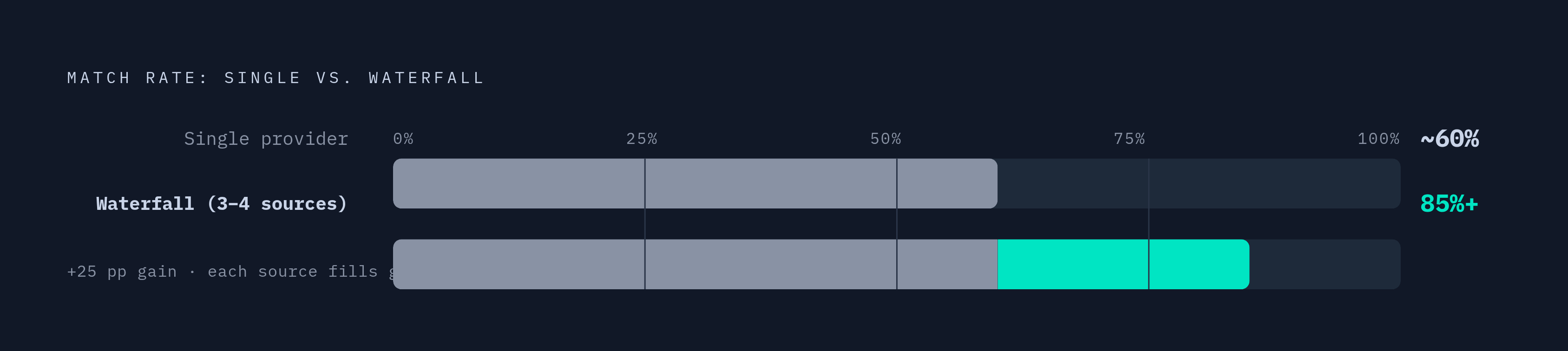
A single enrichment provider cannot reliably cover all fields at all required cadences. Provider coverage is uneven by field type and by geography, which means the cadence framework requires a multi-source architecture to execute. The coverage gap is structural. A single vendor's match rate leaves a material share of records unverified or unenriched, and no single provider clears both the quality and coverage thresholds that a field-level cadence demands. Waterfall enrichment routes each field to a sequence of providers until one of them returns a verified result. It substantially closes the gap compared to single-source lookup. Match rates move from roughly 60% with one provider to above 85% across a waterfall of three to four sources.
Provider strength is also uneven by field. Some vendors have deep email coverage but shallow phone coverage. Others are strong on European firmographics but thin on U.S. direct-dial data. If your enrichment architecture has a structural coverage ceiling, refreshing the same single provider more often gives you diminishing returns. It just confirms the same gaps faster. A field-level cadence only delivers on its promise when each field can actually be refreshed at its required frequency, and that requires more than one source.
Geography and compliance add a second dimension. If you sell into EMEA, you face GDPR constraints on which providers can legally supply certain field types. Compliance posture has become a primary vendor selection criterion alongside data freshness. A cadence that works legally in the U.S. may require a different provider stack in European markets. The infrastructure question, then, is not which vendor is best overall. It is which combination of providers can cover each field at the cadence that field requires, in the geographies where the team actually sells. Apollo's platform, which combines verified contact data with enrichment across multiple signals in a single workspace, is one concrete example of a platform built to support field-level, multi-signal enrichment workflows.
Building the operational process that keeps field-level cadence running
A technically sound cadence framework will fail without an owner, validation rules at entry, and event triggers that fire automatically. The operational layer is what converts a refresh schedule into a living system. The first failure mode is the ownership gap. Without an owner, even well-designed cadences drift: triggers go unmonitored, batch jobs fail silently, and the system regresses to a stale state faster than anyone notices. Someone has to be responsible for watching the metrics and acting on them.
Validation at the point of entry prevents decay from compounding. Set field validation rules in the CRM, and you block invalid entries such as malformed emails, missing domains, and freeform title fields before they become the baseline a future enrichment pass tries to correct. Real-time enrichment of inbound records, before they are routed to a rep, means the baseline is verified rather than assumed. An inbound lead that arrives with a verified title and employer never enters the decay cycle at all.
Event triggers are more reliable than calendar-only schedules for high-velocity fields. Job-change signals, email bounce events, funding announcements, and acquisition alerts each fire a targeted enrichment action against the specific record affected. That is the difference between catching a change in hours and catching it in the next quarterly batch, two months after it happened. Keepsync's 2026 analysis identifies automated job-change tracking and real-time CRM updates as the core fix for the highest-velocity decay problem.
The metrics that tell an owner whether the cadence is holding are specific. Duplicate rate, field completion rate by field type, email validity rate measured against hard bounce benchmarks, and data freshness age by field are the signals that expose drift before it compounds. And there is a trust loop at the end. When reps can see that records were last verified recently, they stop building shadow spreadsheets. The CRM becomes the source of truth rather than the system they distrust.
What teams recover when refresh cadence matches field decay velocity
The payoff from field-aligned refresh cadence is not just cleaner data. It is recovered revenue, reduced rep waste, and an AI-ready foundation that compounds over time. Under-refreshing high-velocity fields carries a distinct cost. Apollo's analysis frames it as a trust problem as much as a data problem: when reps cannot rely on the CRM, they route around it, and the organization loses a single source of truth. Over-refreshing low-velocity fields carries a quieter cost. If you spend budget re-verifying industry classification monthly, you do not have it for continuous employer monitoring. Cadence miscalibration is an allocation problem, not just a hygiene problem.
Proper calibration recovers specific things. Inbound leads enriched at entry arrive at the rep with verified title and employer, so the manual research step is eliminated. The fields that AI scoring and sequencing tools depend on are the ones refreshed most recently, because cadence was designed around decay velocity rather than calendar convenience. And continuous employer monitoring catches job changes in the active customer base, turning a data hygiene process into a pipeline source through champion tracking.
The compounding effect is what separates this operating model from the annual cleanup it replaces. A field-level cadence that runs continuously accumulates accuracy over months. An annual cleanup project resets and decays again, starting the churn from scratch each year. The architecture matters as much as the schedule. Apollo's platform, which integrates enrichment, verification, and outreach in a single workspace, illustrates the last point: consolidating the enrichment and activation layer eliminates the lag between a record being refreshed and a rep acting on it. That lag is where cadence gains are most often lost in multi-tool stacks. Field-level cadence is not a more complicated version of annual cleanup. It is a structurally different operating model, and it produces structurally different outcomes.