Lead Scoring Model Design for B2B SaaS Inbound Pipelines
Separate fit from engagement to stop lead scores from decaying into activity counters.

An effective B2B SaaS inbound lead scoring model separates fit from engagement. Fit decides whether a lead qualifies, while engagement sets the order in which sales works qualified leads. Weighting, negative scoring, decay, and outcome validation preserve that distinction over time. Without those controls, the model becomes an activity counter.
Why most B2B SaaS lead scoring models stop working within 90 days
A student who downloads enough content can outscore a perfect-fit buyer who visits the pricing page once. That is the characteristic failure of a single undifferentiated score. It allows activity to compensate for an account or role that can never qualify. The resulting error is structural.
Growthspree's 2026 framework identifies three recurring failures, including scoring activity instead of fit, never decaying points, and never validating weights against closed-won outcomes. It also identifies a quieter failure in which sales never helped design the model and therefore routes around it. Meanwhile, new content and campaigns keep adding engagement points, so high scores become common and do less to set leads apart. The decline is easy to miss at first. Marketing continues reporting MQL volume while sales gradually stops using the queue to prioritize work.
The two-dimensional structure that separates fit from engagement
Fit uses explicit firmographic, demographic, and technographic data to ask whether the account matches the ideal customer profile. Engagement asks whether the person is showing buying intent now, using behavioral data. Ortto's 2026 lead scoring guide makes this distinction foundational. A strong ICP match with no engagement is not equivalent to an active lead whose explicit data is incomplete.
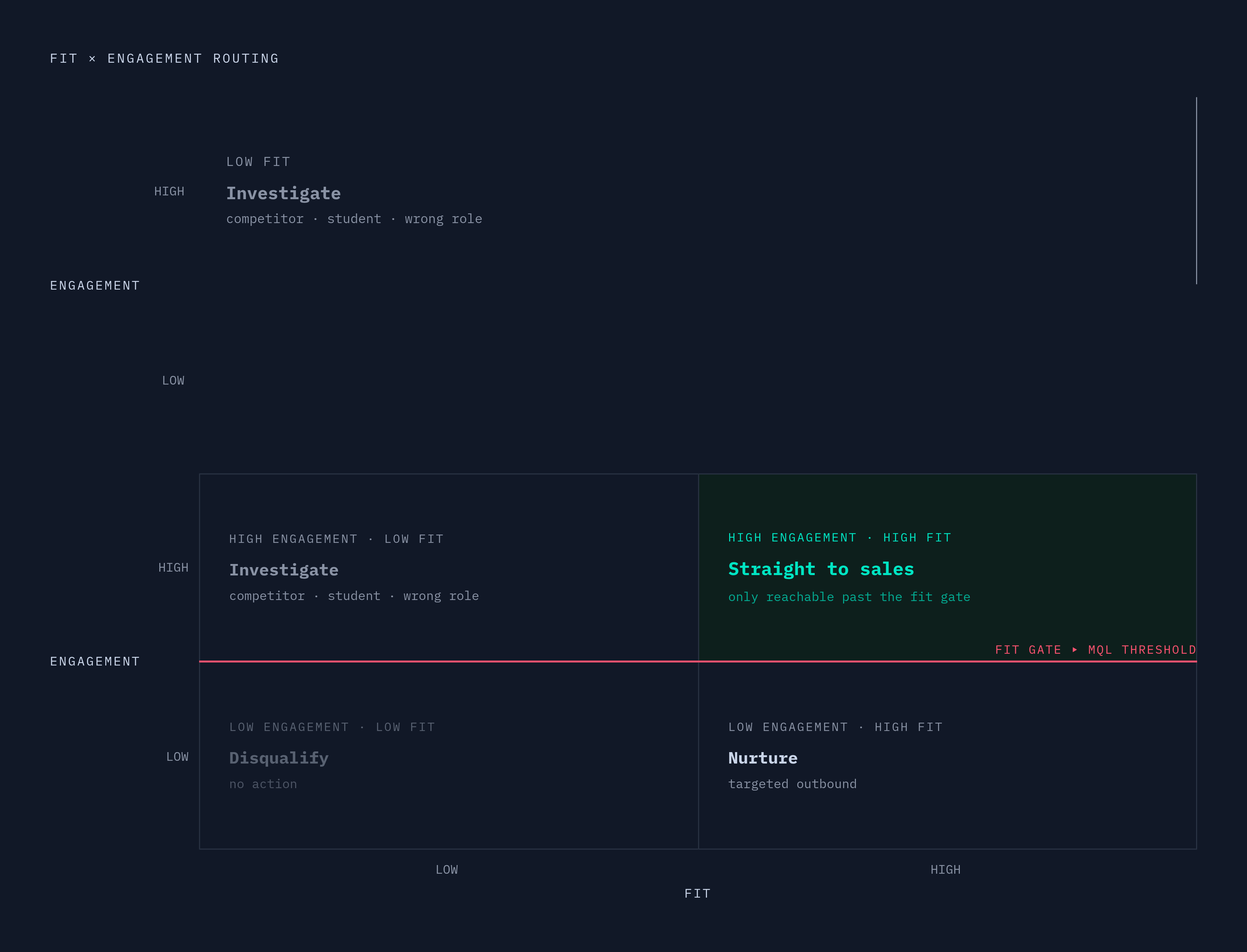
The two-by-two grid translates those differences into action. Leads with high fit and high engagement should go straight to sales, while those with high fit and low engagement should go to nurture or targeted outbound. Low fit and low engagement warrant disqualification or no action. Low fit and high engagement require investigation before action because the activity may come from a competitor, student, or wrong role.
Fit must remain the gate to MQL status. Engagement ranks leads that pass that gate and must never push a low-fit lead through it. Klickbee's 2026 model guide describes a fit-by-engagement matrix, from A1 to D4, as particularly suitable for multiple segments or long sales cycles. Separate axes preserve visibility into high-fit accounts that are not yet engaged, rather than burying them beneath prolific content consumers.
What actually goes into each dimension — and what the signal hierarchy should look like
Signal selection should begin with the company's closed-won CRM history. On the fit axis, company size, revenue band, industry, and geography establish whether the account belongs in the market the company serves. Job title, seniority, and function distinguish buyers, influencers, and end users. Stack compatibility becomes especially useful when the product integrates with or replaces specific tools.
Explicit data also includes declared intent from a form field or sales conversation. That is the highest-signal explicit data and deserves corresponding weight. It should keep its weight even when there are many weaker attributes that are easy to collect. A small set of signals tied to closed-won outcomes is preferable to an exhaustive inventory of available fields.
Within engagement, pricing visits, demo requests, integration or comparison pages, and positive outreach replies rank above content consumption. A standard scoring matrix assigns a pricing-page visit +15 points, but that value is a starting reference. Content downloads, webinar attendance, repeat visits, and engagement from multiple stakeholders in the account at the same time fall in the middle tier. Email opens and single blog visits are in a lower tier. They accumulate easily without establishing purchase intent.
For SaaS, product usage belongs at the top of the engagement hierarchy. Trial activation milestones, features activated, teammates invited, and integrations connected show behavior that marketing-email activity cannot match. In Klickbee's guide, an explicit demo request is enough to send a lead to sales if it passes the fit gate. Growthspree's framework emphasizes recency and frequency rather than raw volume, so repeated low-intent activity should not automatically overwhelm a stronger buying signal.
Negative scoring as the fastest single upgrade to a mediocre model
A positive-only model has no effective way to reject accumulating noise. Every new interaction can increase a lead's standing, even when known facts contradict qualification. Negative scoring supplies that missing control. It belongs in the original design rather than in a later cleanup exercise, because it prevents engagement from overcoming evidence that the lead cannot buy.
Growthspree's framework calls negative scoring “the fastest single upgrade to a mediocre model”. It notes that a handful of disqualifiers, including competitor domains, student roles, and unserviceable geography, typically clean the MQL queue faster than positive-weight tuning. Ortto's guide also says that scores are often too high and hard to trust when negative scoring is missing. Wrong company size or industry should reduce a score even when content engagement is high. Activity does not change whether the company can serve the account.
Other negative signals include personal email domains such as Gmail or Hotmail, which can indicate a non-buying account or an unverifiable identity. Job seekers, roles outside the buying committee, careers-page visits, unsubscribes, and prior hard disqualification reasons also provide grounds for deductions. The deduction must be strong enough to work. A competitor-domain penalty that three content downloads can erase does not suppress the lead and leaves the underlying gate open.
Score decay and why interest from six months ago is not intent today
Negative scoring accounts for evidence against a lead, while decay accounts for evidence that has grown old. A lead can remain a good account match after its buying interest has gone cold. Without decay, that lead retains the behavioral standing earned months earlier and competes with prospects who are active now. The queue then ranks historical curiosity as current intent.
A common approach reduces engagement scores by 10% for every week of inactivity. Recency and frequency should govern the weight that remains. A pricing-page visit last week should outrank five ebook downloads from the prior quarter.
Decay belongs on engagement. Industry, company size, and job title do not expire in the same way as behavioral intent. Without that distinction, follow-up conversations expose the mismatch between a high score and a lead who barely remembers the interaction that produced it. Sales then has a concrete reason to distrust the queue.
Choosing the right model type for the company's data maturity
Model choice depends on the volume and cleanliness of closed-deal history. Platform capability alone does not justify predictive scoring. A rules-based model uses criteria the team defines and weights it sets by hand, needs little historical data, and is easy to understand and quick to launch. For earlier-stage SaaS companies at Series A/B volumes, that explainability and ease of debugging typically make additive scoring more useful than predictive scoring.
A rules-based model can still keep the two dimensions separate. The fit-by-engagement matrix combines those dimensions into a grid and suits organizations with multiple segments or longer sales cycles. Growthspree's framework recommends building and validating an explainable rules-based model before adopting predictive scoring when data volume justifies it. Klickbee's guide says to start with the matrix and test predictive scoring once there is enough clean data. Neither approach makes complexity the objective.
Predictive scoring learns weights from past closed-won data and needs a large amount of clean, labeled deal history. Thin data can produce confident but opaque results that overfit noise. A mature hybrid can instead use rules for known firmographic and demographic fit, with machine learning for behavioral correlations and timing. Explainability remains a requirement for sales trust. If sales cannot understand why a lead scored highly, it may bypass the output regardless of technical sophistication.
Go-to-market motion also changes the unit being scored. Product-qualified lead scoring uses activation milestones, features used, and invitations sent, running in parallel with marketing-side scoring. For enterprise SaaS with committee-based buying, account-level engagement and buying-committee coverage replace the individual contact score as the operative signal. These variations change the evidence and its aggregation while preserving the need to distinguish suitability from current interest.
How to set MQL thresholds and get sales to agree on them
To turn the model into an operating decision, sales must help define qualification before configuration begins. Sales contributes knowledge of what precedes a closed deal that marketing does not independently possess. Its involvement therefore belongs in signal selection and weighting. This is a design and trust requirement. A threshold imposed after the model is built gives sales little reason to honor its output.
The MQL threshold should come from comparing the score distributions of closed-won and closed-lost deals. It belongs where those populations separate most cleanly, subject to the fit gate. The threshold should also be an absolute score. Routing the top percentile of whichever leads engaged that week allows qualification to drift as volume changes, even when the underlying evidence has not improved.
Klickbee's guide specifies that every score band must trigger an action, such as automated nurture, an SDR call, or an account executive handoff. This connects the model's distinctions to work that actually happens. Routing speed is part of that connection. A correctly qualified lead left unassigned cannot benefit from the prioritization the score was meant to provide, making routing automation part of conversion performance.
Validating the model against closed-won data and monitoring it after launch
Validation begins by testing whether leads above the MQL threshold convert to SQL at a materially better rate than leads below it. High-scoring leads should also outperform the historical average. If they do not, the model has not demonstrated predictive value, regardless of how reasonable its criteria appear. Closed-won outcomes provide a further test of the weights. A model can produce an orderly queue without distinguishing the leads that become business.
Growthspree's framework recommends monthly reviews of sales rejection reasons. When reps repeatedly reject above-threshold leads for the same reason, that reason calls for a negative criterion or threshold adjustment. Klickbee's guide recommends quarterly recalibration by comparing scores at handoff with subsequent outcomes. Consistent failure among high-scoring leads indicates overweighted criteria. These reviews replace assumptions about signal quality with evidence from the pipeline.
Recalibration also catches different forms of drift. Win-rate drift happens when the ICP changes and the weights in use no longer match which leads convert. Gaming drift happens when reps or contacts raise scores through activity that does not show intent, while content-inflation drift happens when new campaigns give engagement points to a wide range of leads. Growleads' 2025 persona-based model guide recommends monthly data-quality audits for attribute drift. It also recommends journey-stage attributes requiring prospect-generated data because they resist rep manipulation better than activity-log attributes.
The maintenance schedule should combine monthly rejection reviews, quarterly outcome comparisons, and an annual full rebuild if the ICP or go-to-market motion has materially changed. Recalibration is the work required as the product, market, and buyer population change. Ortto's guide says that separate controls for weighting fit and engagement, including product usage events, let teams adjust each on its own. Maintenance can correct the model if those structural choices allow it, but otherwise the model must be rebuilt.