Data Enrichment Field Prioritization for Outbound Segmentation
Prioritize enrichment fields by the decisions they change, not the data you can buy.

Outbound segmentation depends on choosing enrichment fields that change a decision. The right hierarchy establishes reachability, uses firmographics to define the ideal customer profile universe, then adds technographics and live signals to set priority. Field selection, provider choice, and refresh schedules should follow those dependencies.
Why enriching everything is the wrong instinct for outbound segmentation
A team enriches industry, headcount, revenue, funding stage, technographics, and a dozen intent signals, yet only two or three fields change its outreach sequences. The other data never changes a message, tier, or which rep gets the account. Indiscriminate enrichment treats available information as useful information without testing whether the workflow uses it.
Teams can also go wrong by leaving blank the fields they need to make decisions. ZoomInfo’s enrichment guide explains how scoring and routing have less data to work with when industry, company size, and direct-dial data are missing. Datalane’s 2026 guide says that without enrichment, SDRs spend half their day looking up accounts by hand, taking time away from outreach. Both failures call for the same discipline. Enrich the fields the workflow branches on, in the order it depends on them.
What data enrichment actually adds, and why field type determines priority order
Enrichment adds verified external context to existing records. It differs from collection, which creates records, and cleansing, which fixes existing values. Datalane’s guide places cleansing before enrichment so that new attributes do not land on duplicate or mismatched records. That distinction establishes the starting point for field prioritization. More context cannot compensate for attaching it to the wrong account.
The working map contains five field families. Contact fields establish reachability, while firmographics determine which accounts fit the ideal customer profile, or ICP. Technographics refine fit by showing whether an account’s stack supports a competitive displacement or integration play. Behavioral and intent fields, including topic research, website visits, and engagement history, indicate active interest. Signal fields, including job changes, hiring activity, and funding events, supply a timely reason to act.
These functions determine the order of dependency. A research signal does not establish whether a company belongs in the ICP, and firmographic fit does not establish whether a decision-maker can be reached. Contactability is therefore an execution prerequisite, firmographics define membership, and the remaining layers refine priority and timing. The hierarchy is not a requirement to buy every field in every family.
Contact fields as the prerequisite layer: reachability before segmentation
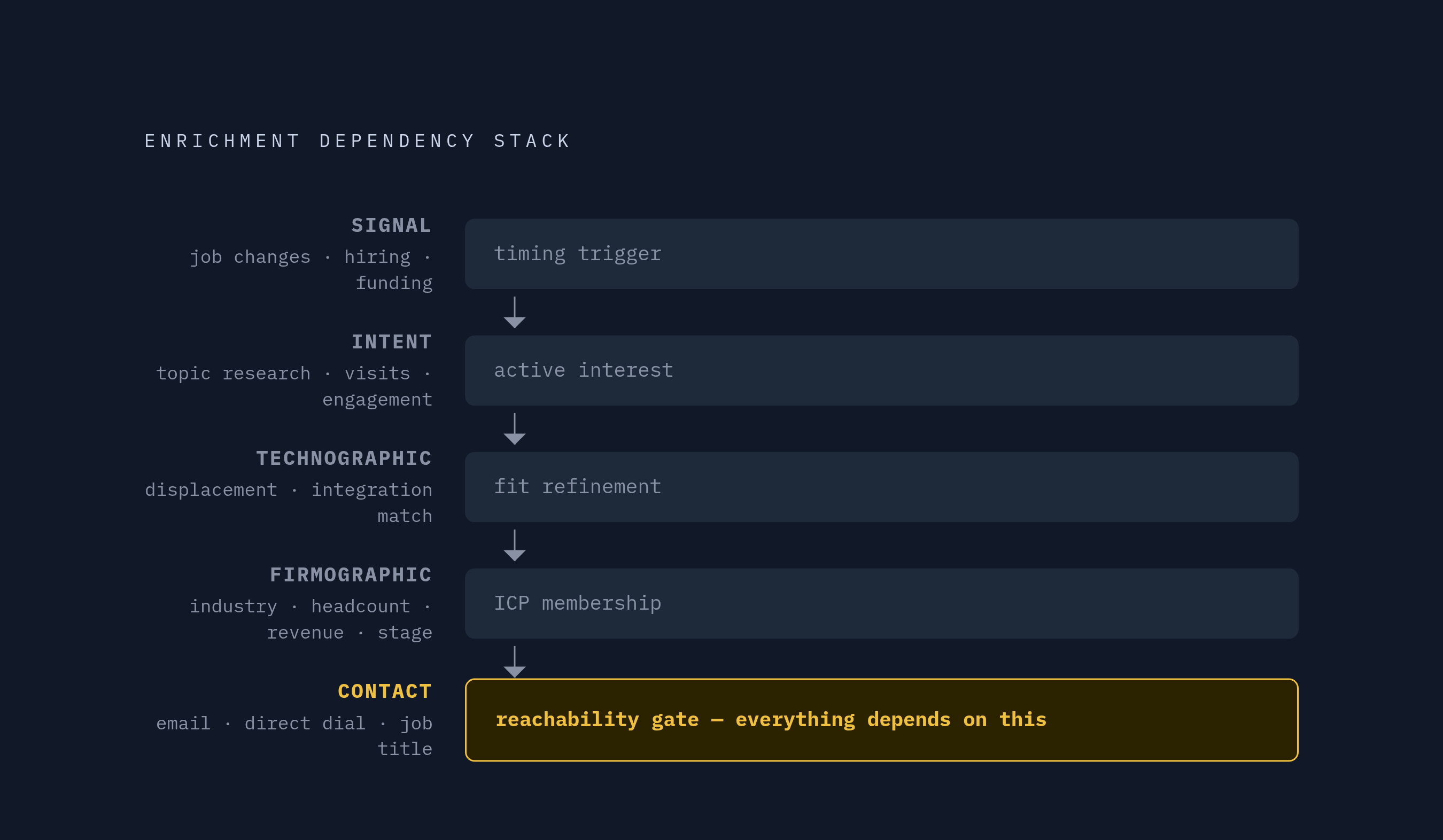
A perfectly segmented account has little outbound value if outreach cannot land. Verified business email provides the deliverability gate, direct dial or mobile improves access to the decision-maker, and current job title and seniority guide message routing and tone. These are the priority contact fields, in that order. Datalane’s guide identifies decision-maker connect rate, rather than merely reaching a receptionist or front desk, as the key predictor of outbound pipeline generation.
Account filtering can precede contact acquisition to avoid spending on companies outside the ICP. That does not make verification optional for the shortlist. ZoomInfo’s guide explains that bounced emails damage sender reputation and weaken deliverability for both the current campaign and subsequent sends. Even a small, high-fit segment can suffer that damage. The contacts in its records must be reachable before they enter outreach.
Verification belongs inside contact enrichment. Cleanlist AI’s 2026 guide specifies SMTP checks for appended emails and line-type checks for phone numbers. It also explains why a confidently wrong number can cost more than a blank one, since a rep will dial it. Because people change jobs and numbers are replaced, contact enrichment must recur after the first append.
Firmographic fields as the segmentation layer: defining the ICP universe before ranking within it
Firmographics determine which accounts belong in the addressable universe. Without them, an account cannot be reliably routed, assigned to a segment, or evaluated against the ICP. This makes firmographic completeness a dependency for downstream account prioritization. The five main fields each derive their value from answering a different membership or routing question.
Industry vertical determines which ICP an account belongs to and which messaging sequence applies. It is the first distinction between a company that resembles the target customer and one that does not. Where different verticals receive different outreach, industry directly controls the branch. Its priority is therefore clear before any intent or technology data is purchased.
Employee headcount provides a common proxy for deal complexity and budget authority. It also feeds territory logic, connecting account size to ownership as well as fit. This field answers a different question from industry. A company can operate in the right vertical but fall outside the size range the outbound motion serves.
Annual revenue band adds a second-order fit signal. It becomes especially useful when a budget threshold is more decisive than employee count. Revenue and headcount should therefore not be treated as interchangeable measures of company size. Their relative priority depends on which one changes ICP membership or routing in the actual workflow.
HQ location supports territory assignment and regional campaigns. ZoomInfo’s guide also identifies its role in compliance routing, including a GDPR flag for EU records. Location belongs here because it changes how an account is handled, rather than because geography requires a separate enrichment program.
Funding stage indicates growth trajectory and purchase capacity. Series A, Series B, and bootstrapped companies can represent distinct buyer profiles even within the same industry and size band. Where those distinctions shape the ICP, funding stage deserves enrichment before more expensive timing signals. A funding stage describes the account’s position, while a new funding announcement later provides a trigger.
Technographic fields as the fit-refinement layer: ranking within the ICP universe
Technographics operate on accounts that already pass firmographic filtering. They do not define ICP membership in this hierarchy. Instead, they show which qualified accounts suit a particular sales play. Competitive displacement targets companies that use a rival product or an incumbent system that is out of date. ZoomInfo’s guide says outreach is more likely to find an opening when a contract is up for renewal.
Integration fit supports a different messaging decision. When a qualified account uses complementary tools, outreach can lead with the integration. Both plays make technology data useful because it changes the message or priority. The practical rule is to enrich technographics only after ICP filtering, avoiding spend on companies that will never enter a sequence.
Provider strength also differs by field family. Cleanlist’s guide names BuiltWith and HG Insights as specialist technographic sources and notes that a single source may be materially weaker in either firmographics or technographics. A waterfall can address that unevenness by sourcing fields separately to strengthen decision inputs.
Intent and signal fields as the timing layer: adding a live reason to act on fit
Fit identifies a plausible buyer, but not a moment. Intent and event signals add evidence that a qualified account deserves attention now. Research activity and website engagement show interest, while funding announcements, executive hires, and relevant job postings show what has changed. Their value depends on the earlier filters. An event at an unsuitable account does not repair poor firmographic fit.
The same guide gives pricing page visits and demo requests the highest values in its scoring framework, followed by job postings and funding rounds, then content downloads. Reps act right away when accounts cross a composite threshold within a rolling seven-day window.
Reachly’s signal-based outbound playbook translates the completed hierarchy into three tiers. Tier 1 combines high firmographic fit, a strong technographic match, and live intent or an event signal, warranting custom research and direct rep action. Tier 2 combines high firmographic fit with a partial technology match and weak or absent signals, supporting a structured multichannel sequence monitored for improvement. Tier 3 contains moderate-fit accounts without strong technology or signal evidence, held for monitoring and re-enrichment.
How signal volume becomes a trap: the case for fewer, better-predictive fields
Signal stacking can easily tempt teams to add more inputs. Yet additional signals help only when the workflow can distinguish their predictive value and act on them. Beyond that point, volume can obscure priority. Evaluate the changes a provider can detect by whether they predict a useful response within a particular ICP segment.
Prospectory AI’s October 2026 enrichment analysis challenges the assumption that a larger database and more vendors improve outbound performance. It argues that tripling the contact database can accompany falling reply rates because the binding constraint shifts from list size to recipient reaction. Its conclusion is deliberately narrow. Most teams need three or four decision-relevant attributes, making forty enrichment fields excessive.
That objection strengthens the hierarchy. The same restraint applies to firmographic attributes, technology data, and timing signals, since any layer can accumulate fields that never change execution. Teams should check their sequences and scoring logic before choosing which data to enrich. An interesting field is a priority only if it produces a different message, tier, or rep assignment.
Field-differentiated refresh cadence: not all enriched fields decay at the same rate
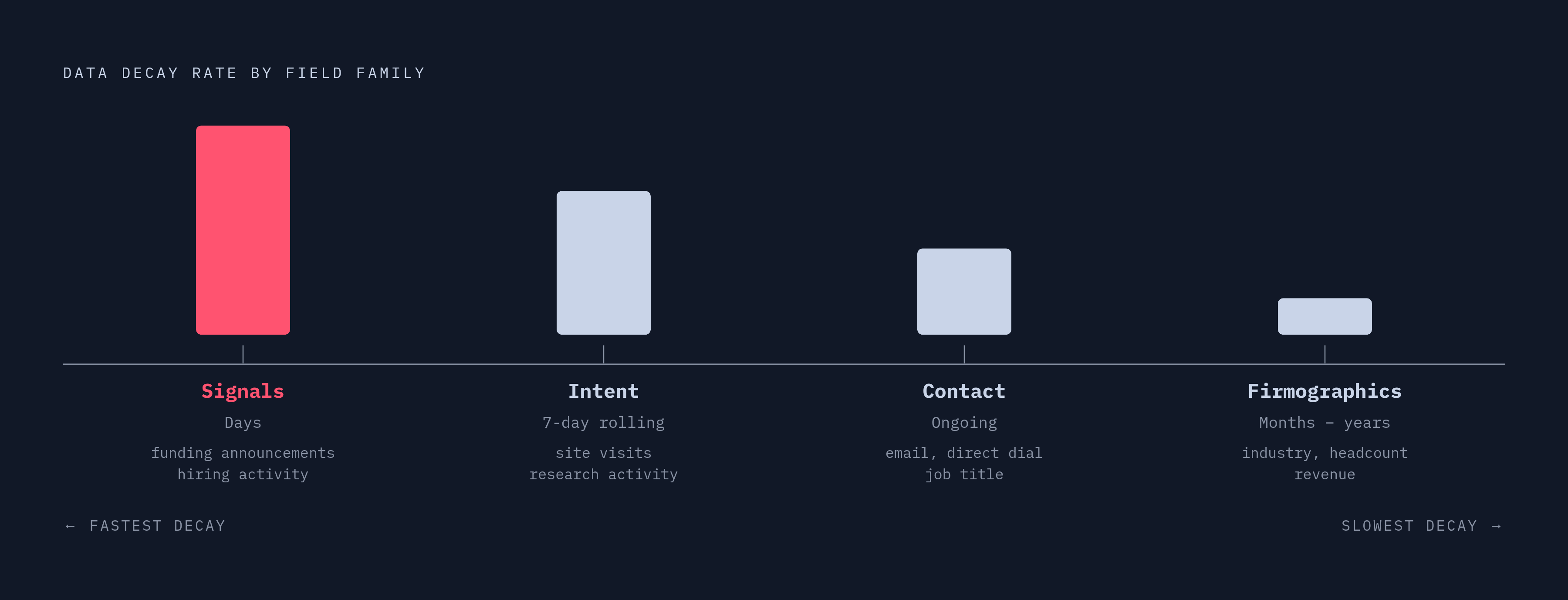
Refresh schedules should follow the useful life of each field. A uniform database refresh spends effort on stable values while allowing short-lived evidence to expire between updates. Contact data needs regular upkeep because jobs, phone numbers, and email addresses change. ZoomInfo’s guide warns that deterioration accelerates without continuous maintenance. Stale contact fields undermine the reachability gate.
Signals have an even shorter window of usefulness. Cleanlist’s guide describes them as the fastest-decaying and most expensive field family because freshness provides their value. A hiring signal that was actionable last week may no longer justify outreach today. Intent and event data thus need to be refreshed differently from the company attributes that show fit.
Firmographics are the most stable family, making less frequent refreshes defensible for most accounts. Industry, headcount, and revenue generally change more slowly than a contact’s current reachability or an account’s active buying signals. Technographics sit between firmographics and signals, changing with contract renewals and tool adoption, which occur less frequently than monthly for most accounts. Schedule maintenance by field family, with separate upkeep for each part of the record. Otherwise, a tier or message can rest on evidence whose useful life has already ended.
Applying the hierarchy in practice: from field selection to a working enrichment workflow
To apply the hierarchy, teams should map enrichment to the gates through which records actually move. The first step is sourcing accounts from a CRM, saved search, or CSV. These records may contain only a company name, domain, or LinkedIn URL. Cleansing precedes the addition of external context. The starting record must represent the intended account before new fields are attached.
The second step is firmographic enrichment to gate ICP membership. Accounts that fail the relevant industry, headcount, and revenue-band criteria exit before further enrichment spend. This purchase order separates inexpensive account qualification from the later requirement that every contact entering outreach must be reachable.
The third step is contact enrichment for qualified accounts. Teams should obtain verified email and direct dial for the relevant decision-maker title, then complete verification before moving the contact into a sequence. Cleanlist’s guide warns that skipping this step is how ostensibly verified lists arrive with high bounce rates.
The fourth step adds technographics to choose which version of a message an account gets. Competitive displacement and integration-fit accounts get outreach that fits their stack, rather than being dropped altogether because they lack a particular match. The fifth step applies intent and event signals to score and tier the resulting pool. Reps act directly when compound signals cross the chosen threshold, while other accounts go into structured sequences or are monitored.
Provider selection should support this sequence field by field. Cleanlist’s guide describes a waterfall in which email can come from one provider and title from another, according to which holds the strongest value. Datalane supports both appending data to known lists and discovery-first enrichment from sources such as licensing databases and permit records. That option is relevant when the ICP includes businesses poorly represented in commercial databases. The governing test remains operational, with every enrichment purchase tied to a gate, message, priority, or timely action.